Press
Blue Origin rocket explosion could damage Nasa's Moon timetable
Images
1 / 9

2 / 9
3 / 9
4 / 9

5 / 9
6 / 9

7 / 9
8 / 9
9 / 9
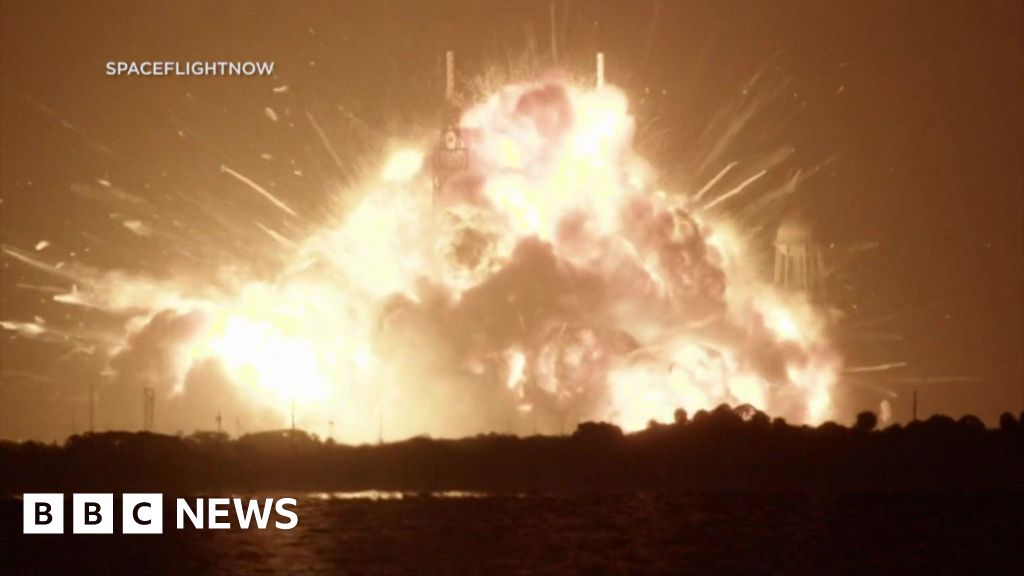
The fireball that lit up the sky over Florida's Kennedy Space Centre last night has put a big question mark over whether Jeff Bezos' Blue Origin can deliver on a string of commitments to Nasa in its efforts to send astronauts to the lunar surface and build a Moon base.

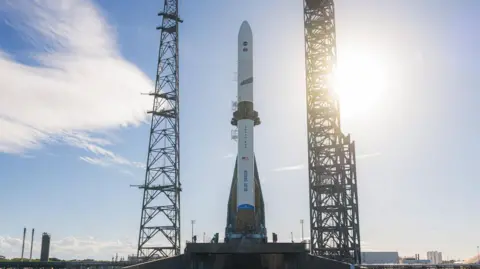
Blue Origin's New Glenn rocket exploded at about 21:00 local time during a routine test of its engines.

The 98m (322ft) rocket had been due to launch 48 satellites for Amazon's Leo broadband network, as early as 4 June.

The explosion is obviously a big setback for the Leo network, which is struggling to be the main competitor for Elon Musk's SpaceX and its Starlink service. But the ramifications will go much further.

The good news was that no-one was injured, despite the spectacular explosion.

"All personnel are accounted for and safe," Bezos wrote on X. "Very rough day, but we'll rebuild whatever needs rebuilding and get back to flying. It's worth it."

But the blast which tore through Space Launch Complex 36 (LC-36) has caused extensive damage. Footage shows one of the pad's lightning protection towers toppling in the aftermath.

LC-36 is the only facility in the world built to launch the New Glenn rocket. That means that until the launch pad is rebuilt and re-certified, Blue Origin has no way to fly its largest rocket - and analysts expect that to take months, not weeks.

The setback comes just days after Nasa's administrator, Jared Isaacman, announced the first three missions of the agency's plans to build a lunar base - a project he billed as the start of a "permanent presence" at the Moon's south pole.

The first, Moon Base 1, is due to be flown on Blue Origin's robotic Blue Moon Mark 1 "Endurance" lander, and is targeted for launch no earlier than autumn 2026.

It is intended to carry two Nasa science payloads to the Shackleton Connecting Ridge and demonstrate the precision-landing techniques needed to keep future crewed landings safe.

But the lander was to ride to the Moon on top of a New Glenn - the same type of rocket that is now scattered across LC-36 - raising immediate doubts as to whether that timetable is now possible.

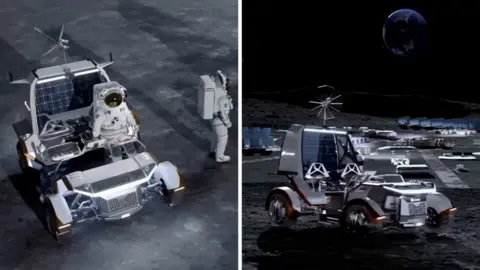
Earlier this week, Nasa also handed Blue Origin a contract worth up to $468m to deliver two commercial lunar terrain vehicles, built by Astrolab and Lunar Outpost, to the Moon's south pole by 2028.

Those rovers are meant to be in place before astronauts arrive. Nasa has set a target date of 2028 for a crewed landing, though that date had been questioned even before last night's explosion.

The destroyed rocket had been due to deploy a batch of 48 satellites for Amazon's Leo broadband constellation - the network formerly known as Project Kuiper which is designed to challenge Elon Musk's Starlink.

Just over 300 Amazon Leo satellites are currently in orbit, all of them lifted by SpaceX, United Launch Alliance and Arianespace rather than by Blue Origin itself.

The gap between Leo and Starlink - which has more than 10,000 satellites in orbit - is now a serious commercial problem for Bezos' group.

Under its US Federal Communications Commission (FCC) licence, Amazon is required to have half of its 3,236-satellite constellation in orbit by 30 July 2026.

As of late May, the company was already more than 1,300 satellites short of that target, with delays blamed in part on "launch vehicle availability" from Blue Origin and other providers.

With New Glenn now expected to be grounded for months, Amazon will be even more dependent on its rivals - chief among them SpaceX - to keep its rollout alive, and is almost certain to need a fresh extension to its timetable from the FCC.

Elon Musk, SpaceX CEO, responded on X to footage of the blast saying only: "Most unfortunate. Rockets are hard."

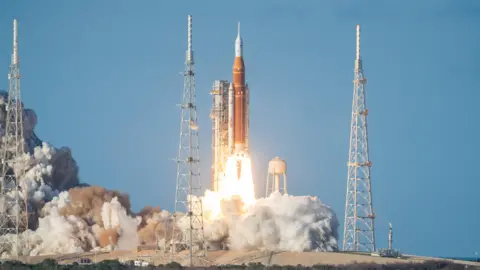
Nasa's next crewed Moon mission, Artemis III, is scheduled to launch next year and is designed to be a low earth orbit flight test of two commercial lunar landers - built by Blue Origin and SpaceX.

Until the explosion, Blue Origin was seen as the more prepared of the two. Its Mark 1 demonstrator was already in final stacking in Florida, while SpaceX's Starship has yet to complete a successful in-space propellant transfer.

All this leaves Nasa's plan to land astronauts back to the Moon by 2028 and to build a Moon base there with several problems which will inevitably now lead to delays.

The lander test for Artemis III depends on the same rocket family, and the Moon Base rover deliveries are contractually tied to New Glenn.

Meanwhile, China is forging ahead with its own plans to land its astronauts on the Moon by 2030, leaving Nasa without much room for manoeuvre.

Nasa Administrator Jared Isaacman responded to the latest setback on X: "Spaceflight is unforgiving, and developing new heavy-lift launch capability is extraordinarily difficult."

But Isaacman's drive to push Nasa's Moon programme to a more ambitious frequency of launches is now seriously in doubt after last night's setback.

A Blue Origin New Glenn rocket exploded on a launch pad at Cape Canaveral in Florida on Thursday night.

The plans include permanent human habitation on the Earth's only natural satellite by 2032.

The 43-year-old police officer and mother of three serves as the team's payload scientist.

The largest and most powerful rocket in history blasted off after its first attempted launch was postponed.

It comes just a day after the firm revealed plans for a record-breaking stock market debut.