Press
Four takeaways from Zohran Mamdani's first 100 days in office
Images
1 / 11

2 / 11
3 / 11
4 / 11
5 / 11
6 / 11
7 / 11
8 / 11
9 / 11
10 / 11
11 / 11
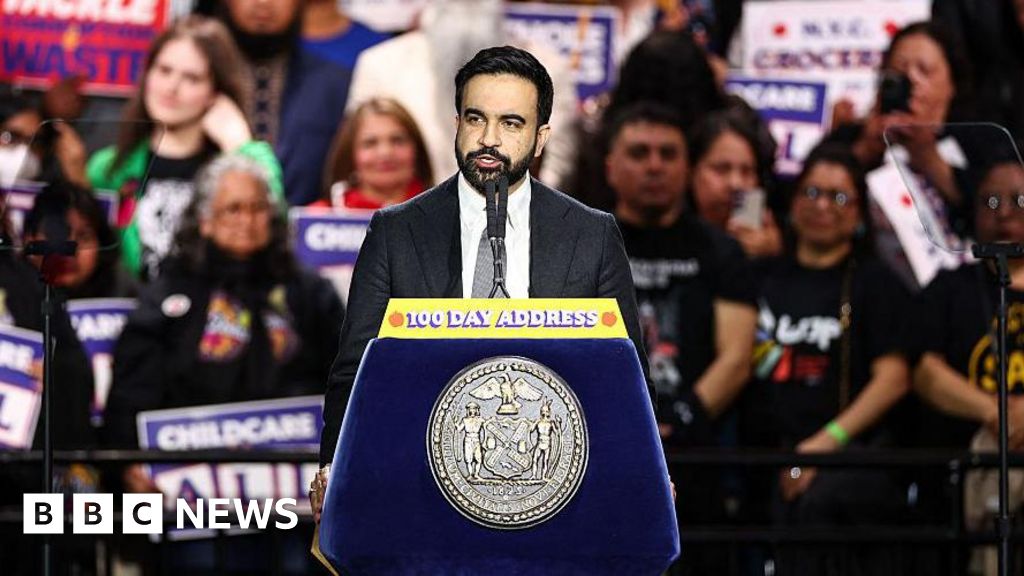
In a packed concert venue on Sunday, New York City's youngest mayor in over a century took the stage to tout his achievements during his first 100 days in office.

Thousands gathered at the Knockdown Center, a former factory in Queens, some carrying signs that said "Pothole Politics" and "Childcare for All".

"Nothing is too big for New York City to take on," Mamdani told them. "And over the past 14 weeks, we have proved that there is no task too small either."

He claimed a number of accomplishments, including securing $1.2bn for child care and fixing 100,000 potholes. But several items from his lofty agenda have yet to be accomplished.

"He's picking some of the stuff that he thinks he can most easily build support with, trying to find issues that have a broad base of support behind them instead of picking potentially divisive issues to start with," said Justin de Benedictis-Kessner,  public policy professor at Harvard University's Kennedy School of Government.

From tackling a turbulent relationship with President Donald Trump to making city buses faster and free, here's where Mamdani stands on several campaign pledges.

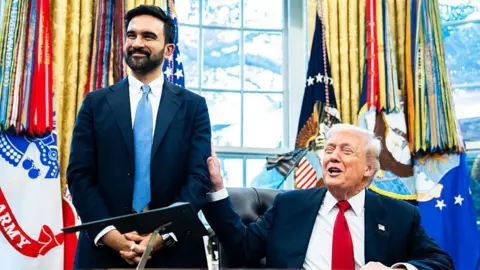
For months leading up to Mamdani's election, the self-proclaimed democratic socialist and the Republican president traded insults. Trump called the rising star a "communist", while Mamdani promised crowds he would not back down from Trump.

But since Mamdani took office, the relationship has proven less antagonistic.

The two met a couple of times, with Trump saying he would be "cheering" for Mamdani. They discussed the affordability crisis in America's most expensive city  and smiled side by side for a photo op.

In fact, Trump at times has seemed "mesmerised" by Mamdani, said Lincoln Mitchell, with Columbia University's School of International and Public Affairs.

"What he's managed to do is thread the needle of not getting Trump's direct ire, and at the same time, not giving in to him."

Perhaps because of the unlikely pair's cordiality, Mamdani has avoided Trump making good on threats to withhold federal funding from New York City, which already operates with a deficit.

And Trump has yet to launch in New York an immigration crackdown like the one in Minneapolis, Minnesota, earlier this year, which led to heightened conflict between federal and local leaders.

One of Mamdani's biggest campaign pledges - at the heart of his affordability agenda - was providing universal childcare for New Yorkers.

Free childcare - a costly goal - is not a reality yet. But he promised $1.2bn (£891,000) to provide 2,000 free spots for two-year-olds by fall 2026 in several lower-income communities, including Canarsie, Brownsville and Ozone Park.

The goal is to grow to 12,000 children by fall 2027 and to reach "full universality" within four years.

New York state Governor Kathy Hochul has committed to fully funding the first two years of the programme - though funding after that is unclear.

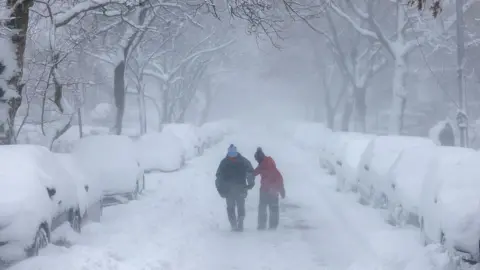
During the mayor's first two months in office, America's largest city saw two of its worst snowstorms in recent years.

Starting on 25 January, the city recorded 13.5 inches of snow in the Bronx, the highest total snowfall of all the boroughs.

Then, on 23 February, almost 20 inches was recorded in Central Park as another blizzard hit the city.

Mamdani faced criticism after at least 18 people died during the first storm and ensuing cold snap.

In February, he took further steps during the harsh weather, freeing up hotel rooms,  placing 1,400 people in homeless shelters, and sending another 150 outreach workers to the streets.

During the January storm, Mamdani said thousands of sanitation workers helped clear the streets and melt 23 million pounds of snow at eight snow-melting sites.

At the Sunday rally, Mamdani announced plans to open a city-owned grocery store in East Harlem by the end of his first term, another component of his affordability campaign. He said he plans to open five, total.

The store will be in La Marqueta, a market started by then-New York Mayor Fiorello LaGuardia in 1936, Mamdani said.

It's expected to cost $30m, according to the New York Times.

New York City already rents properties to private grocery vendors for lower rates and covers operational costs to provide more access to lower-cost food.

Mamdani still has a host of other goals he highlighted on the campaign trail - some  easier to accomplish than others.

"Anybody who thought he would wave a wand and get his big-picture promises done quickly, of course, that was never going to happen," said Mitchell.

Mamdani hasn't yet made progress on lowering rent or increasing taxes to help fund his expensive plans.

In March 2026, for example, the median rent rose to $5,000 a month in Manhattan and $4,150 in Brooklyn, according to a report from real estate firm the Corcoran Group. Mamdani also said he would freeze rent hikes for about 2 million who live in rent stabilized apartments. The mayor does not set this policy, but Mamdani has appointed six of the nine members on the city's Rent Guidelines Board, which  decides the issue. Members hear from landlords, tenants and others before a vote on the matter, expected in June.

De Benedictis-Kessner said that process could yield some sort of compromise rather than a total rent freeze.

"Everything is trade-offs in politics and in governing," he said, adding that after hearing from landlord groups and others, Mamdani's policy might look "slightly different" than what his supporters imagined.

Mamdani's plans for a new department of community safety - to rely on social workers rather than police for non-criminal emergencies - also have proven harder to achieve. Instead of a separate agency with a $1.1bn budget, Mamdani has a mayoral office on community safety with two staff members.

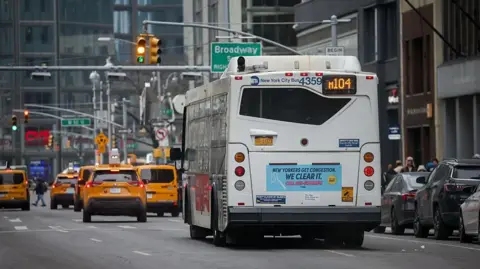
Another cornerstone of his campaign was faster and free buses - but so far that plan seems to be limited to pilot programmes.

Mamdani has long said raising taxes on the wealthy could provide as much as $9bn for his agenda, along with increasing the corporate tax rate from 7.25% to 11.5%.

But the mayor needs the support of the state to make tax changes. Hochul -  making her own political calculations as she runs for re-election this year - has indicated she wants to avoid raising taxes.

"That's going to be the challenge," Mitchell said. "Because if she doesn't [raise taxes], he's really limited in what he can do."

Crude prices fall back below $100 a barrel as markets hope an agreement can be reached between the two sides.

Their relations remain warm just as those between their leaders seems decidedly chilly, Chris Mason writes.

Hours after posting a lengthy message critiquing the pontiff, the US president shared a Jesus-like image of himself that he has since deleted.

BBC's Sarah Smith looks at how the president's most ardent supporters are reacting to his latest social media posts.

Legislation ratifying the agreement will not progress this parliamentary term due to a stand-off with the White House.