yahoo Press
Advocates embrace Wisconsin law allowing DACA holders to obtain occupational licenses
Images
1 / 10
2 / 10

3 / 10

4 / 10

5 / 10

6 / 10
7 / 10

8 / 10

9 / 10

10 / 10
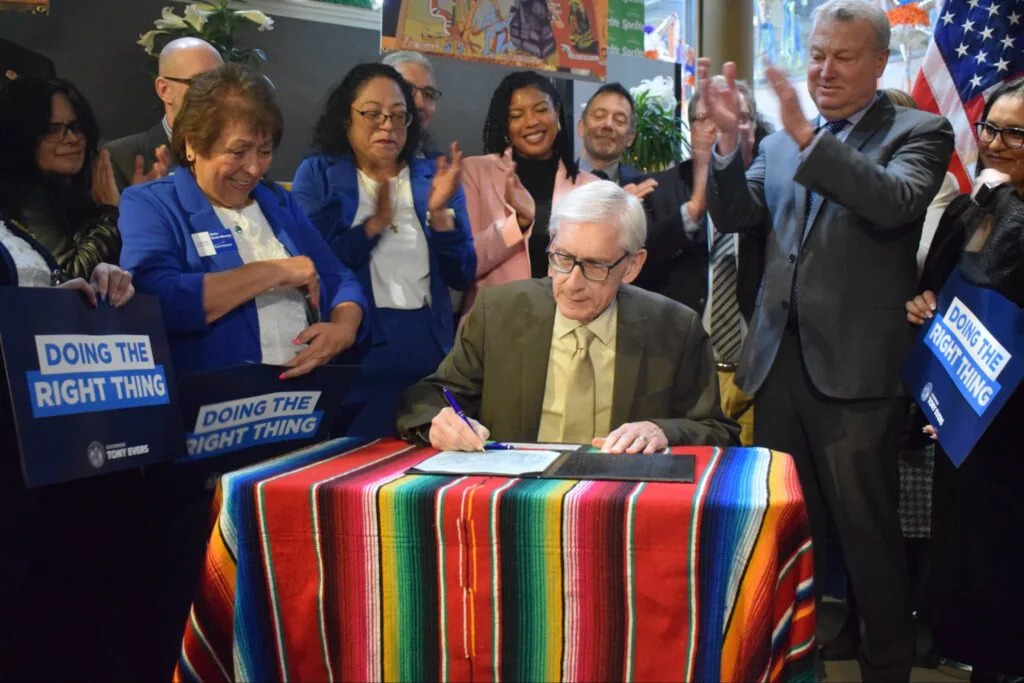
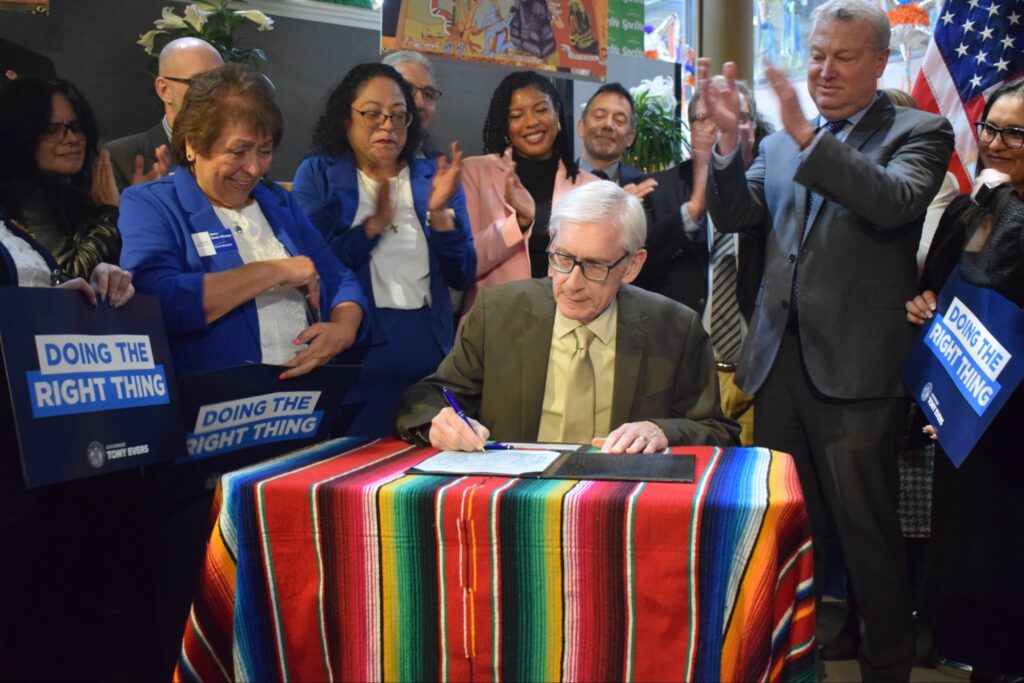
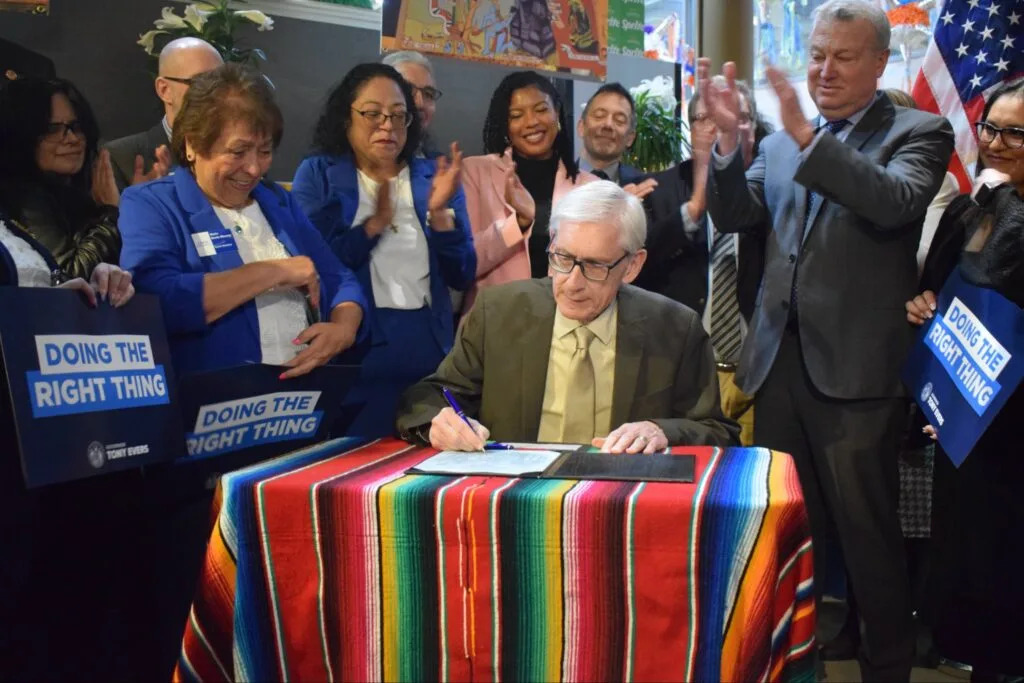
Gov. Tony Evers signed a measure into law allowing DACA recipients to get occupational licenses while surrounded by advocates at the Nuevo Mercado El Rey in Milwaukee. (Photo via Evers' official X account)

Wisconsin will officially allow DACA status holders to obtain an occupational license under a bill Gov. Tony Evers signed into law last week.

AB 759, now 2025 Wisconsin Act 240, allows DACA status holders to apply for and obtain professional credentials from the Wisconsin Department of Safety and Professional Services (DSPS).

Evers said in a statement that it was the right thing to do to help “Dreamers… pursue their higher education and career goals to give back to the communities that raised them” and to help the Wisconsin economy by ensuring “smart, talented and capable people can join our workforce in high-need areas.” He signed the bill while surrounded by advocates at the Nuevo Mercado El Rey in Milwaukee.

“Here in Wisconsin — whether it’s restrictions on obtaining a driver’s license to operate a vehicle or certain work-related credentials — unnecessary barriers are holding hard-working people, as well as our workforce, economy, and communities, back,” Evers said in a statement. “Immigrants play a critical role in our economy and our communities in every corner of our state — and they have for generations. In Wisconsin, we’ve always believed that if you work hard, obey the law, pay taxes, and play by the rules just like everyone else, you should have a fair shot at pursuing the American Dream, including having the opportunity to join our professional workforce.”

The bill made it through Wisconsin’s Republican-led Legislature and to Evers at a time when the federal government has been cracking down on immigrants, detaining more than 260 DACA recipients and deporting more than 80.

Proponents of the legislation got it over the finish line using the tag line, “This is not an immigration issue; this is a workforce issue.”

The Deferred Action for Childhood Arrivals (DACA), adopted in 2012 under President Barack Obama, provides temporary protection from deportation and work authorization to certain undocumented immigrants who were brought to the U.S. as children. The program does not provide recipients with legal status, a path to permanent residency or citizenship.

According to a September 2025 report by the Migration Policy Institute, there are about 505,000 active DACA recipients from close to 200 different countries of birth in the U.S, about 5,100 of whom reside in Wisconsin.

DSPS issues thousands of licenses for more than 200 types of jobs in the health, business trades and other fields each year in Wisconsin. Nurses, real estate agents, cosmetologists, plumbers, dentists and emergency medical technicians all receive licenses through DSPS.

Without the change in state law, DACA recipients have been ineligible to apply, limiting the types of jobs they can do in Wisconsin.

Under the law, workers will still be required to have a valid, unexpired employment authorization document issued by the U.S. Department of Homeland Security, and as long as the federal work authorization is renewed, their Wisconsin credentials may continue to be renewed.

Under the law, the bill will only apply to DACA recipients under the original DACA program. President Donald Trump rescinded the DACA program in September 2017. The provision in the state law means that should DACA be reopened to new applicants, they would not be eligible for occupational licenses.

Erika Colón, who has been a nurse for more than 30 years, told the Examiner that the legislation could help relieve the nursing shortages in Wisconsin. Colón, who spoke to the Examiner in her personal capacity, is the president of the Milwaukee Chapter of the Hispanic Nurses Association.

“I’ve never worked in a hospital where we were fully staffed, and it wasn’t because the hospitals didn’t want to hire. It’s just that the people didn’t exist,” Colón said.

According to a 2024 Wisconsin Department of Workforce Development (DWD) report, the state faces a projected deficit of 12,000 to 19,000 registered nurses by 2040.

In her work with the Hispanic Nursing Association, Colón said that she has met students pursuing nursing who were DACA holders, but had to relocate out of the state to practice. She noted that the shortage issue is a nationwide trend.

“In the big picture, it does help that they became nurses, and they’re helping other states, but they’re from here. They lived here many years. Their families are here. Their roots are here, and essentially we need them here,” Colón said. “We have so many job openings to fill that people could be filling easily, and unfortunately, because of the licensure barriers, they have to pick up everything and move out.”

Advocates worked hard to push through the new policy allowing DACA recipients to work in Wisconsin, instead of moving and taking their skills to other states.

A bill allowing DACA recipients to get occupational licenses was first proposed in 2023 by former Rep. John Macco, a Republican from Brown County. He worked on a package of bills, including one to allow DACA recipients to become police officers and one to allow DACA recipients to be eligible for in-state tuition at Wisconsin’s universities, with Rep. Sylvia Ortiz-Velez (D-Milwaukee). He had heard from local law enforcement in Green Bay that one of their employees was not eligible to become a police officer due to his status. The bills did not advance that session and Macco opted not to run for reelection in 2024.

“For me, it was a jobs bill,” Macco told the Examiner in an interview. “We are graduating nurses… They went to grade school here, high school here, college here, and then they have to leave the state of Wisconsin to get a license and to sit for their nursing boards and practice somewhere else. It’s the dumbest thing you’ve ever seen. They can’t even be a barber in the state of Wisconsin.”

This session, Rep. Joel Kitchens (R-Sturgeon Bay) signed on as lead coauthor this session alongside Sen. Jesse James (R-Thorp) and Ortiz-Velez. The lawmakers intentionally decided to focus their efforts on just the occupational license bill.

Ortiz-Velez told the Examiner that getting the bill done was a team effort. She said the recent national environment surrounding immigration was in the background as lawmakers and advocates worked on the bill.

“People have such negative images, and they automatically assume that this is gonna promote illegal immigration and where they don’t understand is this is a finite group of people,” Ortiz-Velez said. “It took a lot of us explaining and educating people and being very precise in the messaging that we were using to make sure that people understood. This is not an immigration bill.”

There were obstacles to getting committee hearings. Rep. Shae Sortwell (R-Two Rivers), the chair of the Assembly committee where the bill got a hearing, is a staunch supporter of Trump’s immigration agenda. He ended up speaking in favor of and voting for the bill, but some Republicans who share his views on immigration were opposed to the measure from the beginning. When it came to the final floor session, the bill was not initially listed on either the Assembly or Senate’s calendars.

Ortiz-Velez said it was helpful to keep the conversation focused on Wisconsin, rather than federal immigration policy.

“As a state, we have to put Wisconsin first, and regardless of what’s going on at the federal level, we have job openings that we have, and we have people that are qualified… I think for Republicans that was important to them — the idea of losing workforce,” Ortiz-Velez said.

Ortiz-Velez said it was unclear during the Assembly’s last week in session whether the bill would get a vote. But in the end, Republicans and Democrats spoke in favor of the bill and it passed in a bipartisan voice vote.

Macco remained involved in the effort to get the legislation over the finish line including in the Senate.

“My point to the Legislature was, look, conservative Republicans can walk and chew gum at the same time,” Macco told the Examiner in an interview. “We can both be against illegal immigration and breaking the laws and criminals coming into our country at the same time, we want to make a path for citizenship to all of those DACA recipients, and Congress needs to do that.”

Macco testified at the committee hearing on the bill. He also made calls to his former Republican colleagues.

“I called a bunch of them. I remember calling [Senate President] Mary [Felzkowski] and she called me back,” Macco said. “I had that conversation with her on how this is so important while I was riding on a ski lift… My request to her was, would you be willing to waive the 17 rule or go to a voice vote.”

The “rule of 17” is an informal rule sometimes invoked by Republicans in the state Senate, who have insisted that only bills that have the support of the majority of the Republican caucus should be allowed to come up for a vote. This informal rule has stymied bipartisan efforts that could have passed with votes from members of both parties. With an 18-15 Republican majority, any two Republican senators can block a bill from getting a floor vote under the “rule of 17.”

Senate Majority Leader Devin LeMahieu (R-Oostburg), who is retiring at the end of his term, broke the rule to pass a handful of bills during the Senate’s final floor session this year.

On the last day of the Senate floor session, the DACA licensing bill was still not on the calendar. Ortiz-Velez said that was a purposeful maneuver to avoid any amendments on the bill that could have killed it.

The bill passed in the Senate 31-2. The only opposing votes came from Sens. Andre Jacque (R-New Franken) and Steve Nass (R-Whitewater).

After the vote, Sen. Tim Carpenter (D-Milwaukee) said in a statement that it was a “great accomplishment” for the state.

“Dreamers came to our nation as children, brought by their parents because America has long held itself to be the land of opportunity,” Carpenter said. “That is the same reason that many proud Americans live freely in our great nation today, because our ancestors once had that same dream of building a better life for their children.”

Colón said her members wrote to lawmakers and Evers as a part of their advocacy efforts and worked to educate and win support of people who wouldn’t be directly affected. Before they heard about the bill, she said, “a lot of people didn’t know that DACA recipients could not obtain the license.”

“We need this. Licensed professionals are highly needed in the state. It’s not like they’re taking other people’s jobs,” Colón said.

Colón said she knew of at least two nurses who would be able to move back from Illinois.

“This will be able to bring two people back to the workforce here and to care for our communities that greatly need it,” Colón said.

Ortiz-Velez said she is hopeful the success of the law could open the door to additional legislation for DACA recipients. She said in-state tuition is one of her top priorities. She said she also hopes that working with others on these issues could also “reinvigorate” a conversation about a path to citizenship for DACA recipients, so that “they can be fully members of our society.”

Macco said that he would like to see the state take more action to address the barriers that DACA recipients face, however, he also called them “Band Aid approaches.”

Macco said he wants to see the federal government allow DACA recipients to apply for a green card. He said that he plans to speak with Wisconsin Sen. Ron Johnson and Rep. Tony Wied about the issue.

“[It] doesn’t mean they’re going to get it. It just allows them to apply, and so if [the federal government] would just simply do that, to me, I think that’s a win,” Macco said.

SUBSCRIBE: GET THE MORNING HEADLINES DELIVERED TO YOUR INBOX