yahoo Press
289-million-year-old mummy fossil presents earliest evidence of rib-based breathing
Images
1 / 10
2 / 10

3 / 10

4 / 10

5 / 10
6 / 10
7 / 10

8 / 10

9 / 10

10 / 10
Take a deep breath. Feel your ribs flare, and your chest expand. That simple, rhythmic motion is a biological inheritance nearly 300 million years in the making, and we finally have the "mummy" to prove it.

Paleontologists have unveiled a tiny, lizard-like fossil that is rewriting the manual on how land animals conquered the Earth.

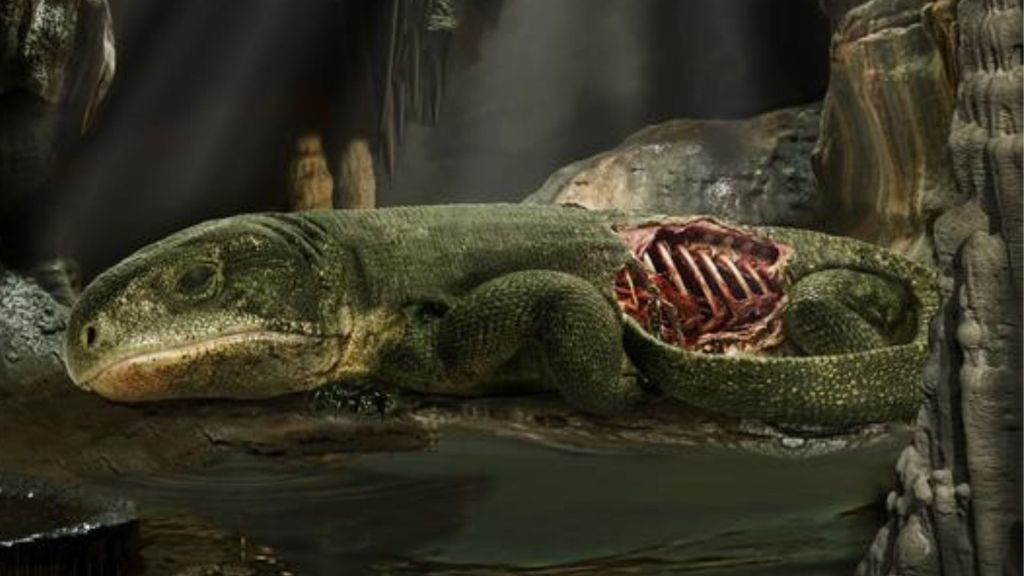
The creature, Captorhinus aguti, died in a cave in Richards Spur, Oklahoma, US, roughly 289 million years ago (early Permian period).

Thanks to a bizarre cocktail of oxygen-free mud and ancient oil seeps, it was mummified in three dimensions.

This unique environment protected fragile soft tissues, such as skin and cartilage, which usually vanish over time, leaving the specimen frozen in its natural death pose.

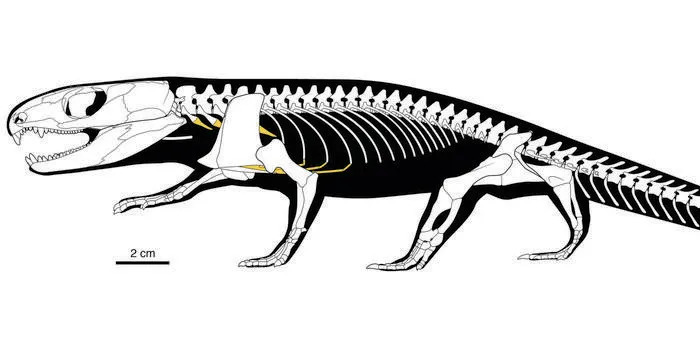
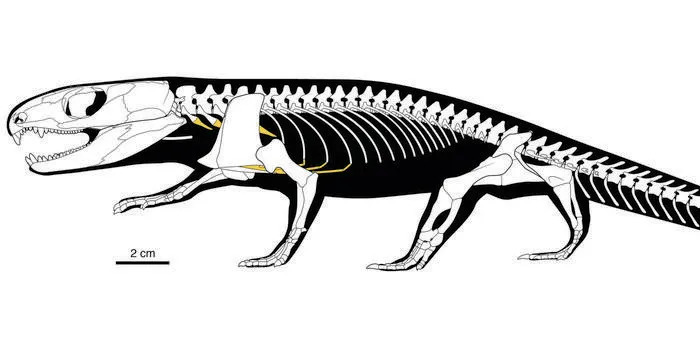
The fossil has revealed the oldest known evidence of a costal breathing system. It showcases the ancestral mechanism by which amniotes — reptiles, birds, and mammals — breathe today.

"Captorhinus is an interesting lizard-looking critter that is critical to understanding early amniote evolution," said Ethan Mooney, who co-led the study, and a PhD candidate in the Department of Organismic and Evolutionary Biology at Harvard University.

Despite its small size of just a few inches, this mummified fossil contains organic molecules nearly 100 million years older than the previous record-holder, a dinosaur.

In this new study, the team used advanced neutron computed tomography (nCT) to non-invasively peer inside the fossil.

It revealed a remarkably preserved, "accordion-textured" skin wrapping the animal's torso.

This high-tech imaging, combined with the study of two other specimens, enabled the reconstruction of the first complete breathing apparatus of an early amniote.

The researchers found a complete chest assembly, including a segmented cartilage breastbone and various layers of ribs that anchored the ribcage directly to the shoulder.

It showcased how these ancient reptiles transitioned to the complex, rib-powered respiration used by modern land animals.

This discovery highlights a major evolutionary shift from the inefficient breathing of amphibians to the more powerful costal aspiration system.

Before this, the early amphibians gulped air like water, using their throats to pump oxygen into their lungs. It was an exhausting, inefficient process that limited an animal's activity. Captorhinus changed the rules.

By using muscles to pull its ribs outward, it created a vacuum that sucked air deep into its lungs. This is known as costal aspiration. It was a massive upgrade. More oxygen meant more energy.

More energy enabled them to hunt, run, and thrive in harsh inland environments where their amphibian cousins couldn't follow.

"We propose that the system found in Captorhinus represents the ancestral condition for the kind of rib-assisted respiration present in living reptiles, birds, and mammals," said Professor Robert R. Reisz, the study's co-author from the University of Toronto.

This small reptile represents the ancestral blueprint for almost every land-dwelling vertebrate you see today.

Whether it’s a hawk soaring in the sky, a cheetah sprinting across a savanna, or you sitting at your desk — we all use the rib-powered engine that Captorhinus pioneered in a dark Oklahoma cave during the Permian period.

Now curated at the Royal Ontario Museum in Toronto, these specimens remain accessible to the global scientific community for ongoing research.

The findings were published in the journal Nature on April 8.