yahoo Press
The $7 Billion Loyalty IOU: What Marriott and Hilton Owe Members
Images

1 / 5

2 / 5

3 / 5

4 / 5
5 / 5
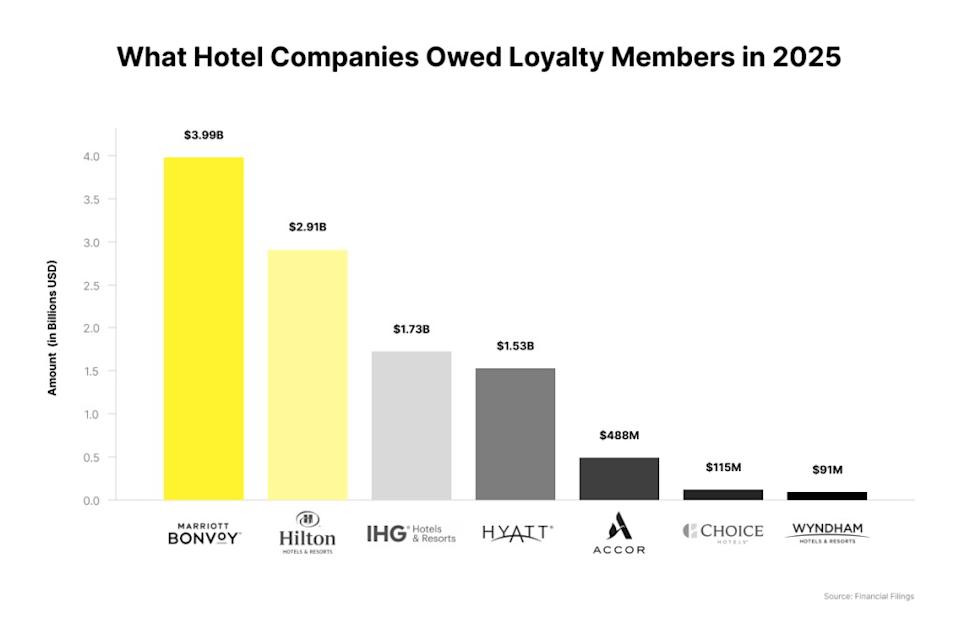
Seven of the world’s largest hotel groups collectively owed their loyalty members roughly $11.6 billion in unredeemed points at the end of last year, according to a Skift analysis of their most recent financial filings.

Marriott alone owes guests nearly $4 billion in free stays and other perks. Hilton owes almost $3 billion.

These loyalty “liabilities” have ballooned in recent years, driven by an explosion in co-branded credit card deals and a surge in loyalty program enrollment.

Yet hotel executives don’t consider these liabilities problematic in the way traditional debt can be.

One reason is that travelers keep racking up points faster than they redeem them, and they typically don’t cash in all the points they earn. At Marriott, the gap between points earned and points redeemed widened by $473 million last year.

What’s happening is straightforward, even if the accounting isn’t.

Let’s say a traveler taps or swipes a hotel group’s co-branded credit card at a grocery store. The card issuer, such as JPMorgan Chase or American Express, essentially pays the hotel company for the points that the cardholder just earned.

If a traveler stays at a hotel, the hotel will essentially pay the hotel group a fee to support the loyalty program.

In either case, cash essentially comes in the door, though the timing of that can get complicated behind the scenes.

The hotel company can’t simply account for all of those loyalty redemptions right away. The “value” of the points sits on the balance sheet as a “liability,” or an IOU to the traveler.

While a hotel company is waiting for travelers to burn their points, it can essentially tap into some of that deferred revenue as “a float.”

IHG disclosed that its loyalty program generated $74 million in additional working capital last year, in addition to the $37 million in upfront cash from new U.S. credit card agreements.

The numbers as of December 31 reveal a steep hierarchy. Marriott had the largest obligation, owing $3.99 billion to guests.

Hilton ranked second at $2.91 billion.

The difference is notable given that their membership counts are roughly comparable. Marriott had nearly 271 million at the end of last year. Hilton had over 243 million members.

However, Marriott Bonvoy members earned 37% more points value last year than Hilton Honors members did, a gap that is proportionally much wider. One explanation is that Marriott simply offered more places to stay, with 31% more rooms than Hilton.

Expect hotels to pledge their loyalty programs as collateral for debt. This securitization would mirror what airlines have already done with their much larger programs. For instance, Delta raised $9 billion in financing secured by SkyMiles during the pandemic.

The hotel loyalty pool of deferred revenue, or contractually funded cash, essentially backed by reliable consumer spending patterns and major credit card issuers, is exactly the kind of asset that attracts structured-finance attention.

The numbers need to grow bigger for this to happen, however, and it’s not clear how long it will take. Marriott’s loyalty IOUs to guests have grown by over 40% over a decade, in tandem with its expanding loyalty program membership, co-branded credit cards, and efforts to drive engagement.

Other hotel groups have thriving programs, too. IHG owed $1.73 billion, Hyatt owed $1.53 billion, and Accor owed $488 million, as of December 31.

Notably, Wyndham and Choice Hotels each carried roughly $100 million in loyalty liability.

In a sense, the value of what people had earned in Marriott’s program was 20 times that of what they had earned in Wyndham and Choice’s programs combined.

One explanation is that the Marriotts of the world had much larger luxury footprints than Choice and Wyndham.

This dynamic hints at how much the loyalty game favors companies with many aspirational, luxury properties, inspiring people to hoard their points for dream-trip redemptions. Marriott has over 500 luxury hotels and resorts, while Wyndham and Choice only have dozens.

Another large hotel group that lacks many luxury hotels is China’s H World. It hasn’t yet released comparable figures. But for context, as of December 2024, its loyalty members earned about $49 million (338 million renminbi) in value in the H Rewards loyalty program.

Not every point will ever be redeemed. Some members go inactive. Some rack up balances they’ll never touch. The industry calls this “breakage,” and estimating it is one of the most consequential judgment calls in hotel accounting.

When points go unredeemed, the hotel company can recognize deferred revenue without providing a free night. “Cash” came in from the credit card partner, but no one has stayed at the hotel yet. In a sense, that’s pure margin in the near term.

But breakage is a double-edged sword. A member who never redeems their points is a member who’s disengaging by not booking paid stays with your brand instead of your rival’s, or not swiping your co-branded card and generating fees. High breakage can slowly starve your flywheel.

In other words, when a guest earns points, the hotel group gets the “cash” value in the loyalty program. What’s at issue is when that value shows up on the P&L.

Marriott estimated that a single percentage-point change in its breakage assumptions in 2025 would shift its loyalty liability by roughly $50 million. Other hotel groups disclosed similar dynamics.

These estimates rely on actuarial models that outsiders can’t fully audit. Some experts believe the incentives tend to cut one way, since higher breakage flatters current earnings.

Get breaking travel news and exclusive hotel, airline, and tourism research and insights at Skift.com.