yahoo Press
‘An Attractive Entry Point’: Bernstein Upgrades Western Digital (WDC) Stock Following Sell-Off
Images
1 / 4
2 / 4

3 / 4

4 / 4
Western Digital (NASDAQ:WDC) has been among HDD and Memory stocks representing some of the market’s best performers over the past year, benefiting from AI workloads’ rising memory needs. However, Google’s recent TurboQuant report put a spanner in the works for names in the cohort.

Unlock  hedge fund-level data  and  powerful investing tools  for smarter, sharper decisions

Discover top-performing stock ideas and upgrade to a portfolio of market leaders with  Smart Investor Picks

On March 24, Google Research introduced TurboQuant, a new compression algorithm said to deliver a 6x reduction in KV cache memory usage and up to 8x improvements in inference performance on Nvidia H100 GPUs, without any loss in accuracy. TurboQuant specifically targets the KV cache, a component used during inference rather than training, and does not compress model weights, training data, or stored data. As a result, its impact is largely confined to GPU HBM and system DRAM, with only a limited secondary effect on NAND, which is used for offloading cold caches. It has no impact on HDD demand.

Despite the fact that this has no impact on HDD, the market did as the market does and along with other memory stocks, WDC sold off in the wake of the news.

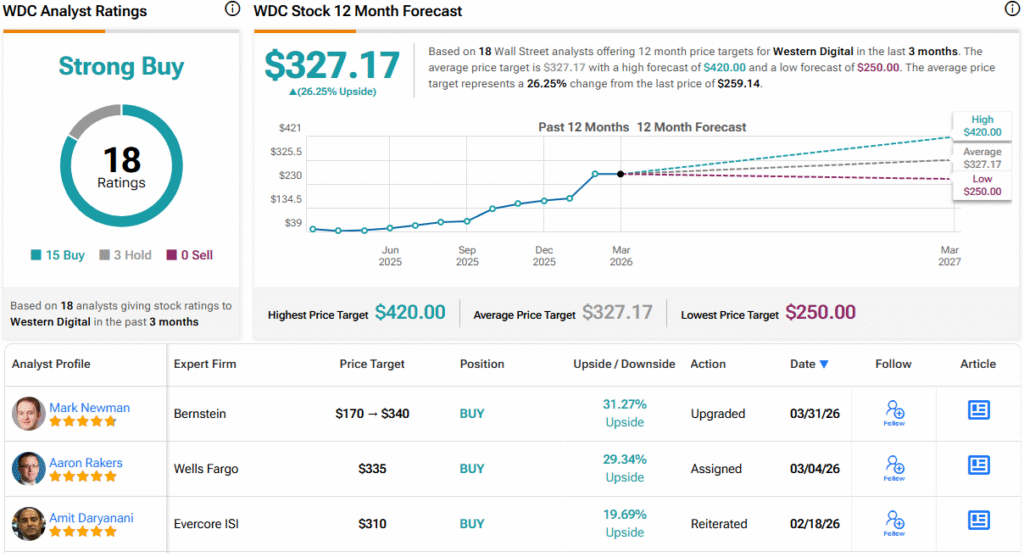
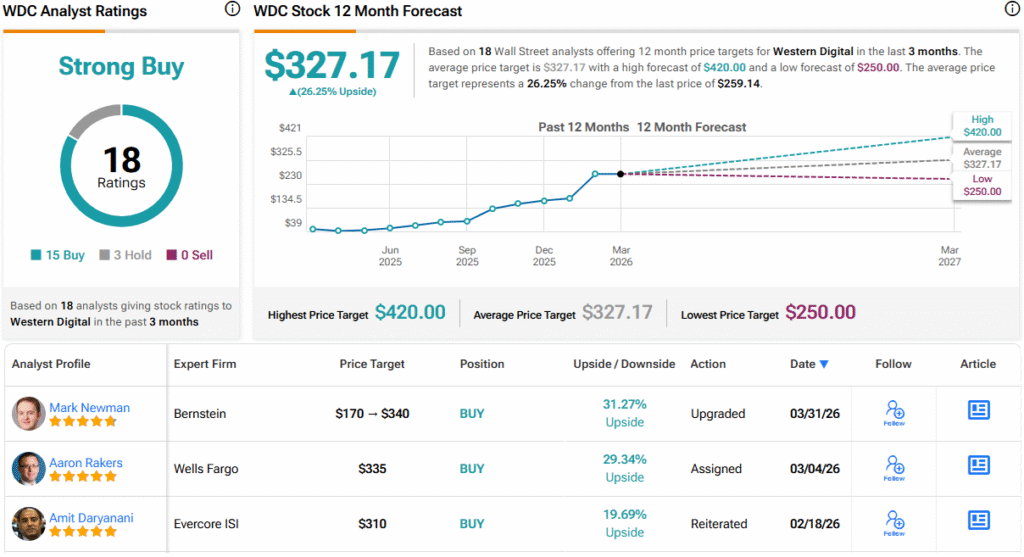
Now, says Bernstein analyst Mark Newman, with the stock sitting 19% below its recent highs, the selloff has presented an “attractive entry point.” Accordingly, Newman has upgraded his WDC rating from Market-Perform (i.e., Neutral) to Outperform (Buy), while also raising his price target from $170 to $340, suggesting the stock will gain 31% over the coming months. (To watch Newman’s track record, click here)

The surge in data generation, with AI playing a huge part, is driving strong growth in storage demand. AI models are generating data at unprecedented scale that must be stored, while training these systems requires large storage capacity for increasingly complex models, and AI-enabled video adds another layer of demand. Total shipped storage capacity across NAND and HDDs grew at a 55% CAGR between 1998 and 2013, then slowed to 14% between 2013 and 2024. Newman anticipates growth will re-accelerate to about 24% annually through 2030, supported by “AI workloads, richer content creation, longer data retention requirements, and stricter data sovereignty standards.”

HDDs are expected to play a key role due to their cost advantage over NAND, which remains in a super-cycle. Within total data center storage demand (HDD + NAND), which Newman forecasts will grow at a 31% CAGR, data center HDD demand should rise at a 25% CAGR from 2024 to 2030, in line with Western Digital’s recent Investor Day presentations. With device-related HDD demand largely displaced by NAND and growing more slowly, Newman forecasts total global HDD shipments will increase at a 23% CAGR.

More specifically, Newman notes that WDC’s Innovation Day implied a solid ePMR roadmap in the short term but also a “soft push-out” of HAMR. ePMR (energy-assisted perpendicular magnetic recording) is an incremental enhancement to existing hard drive recording technology that improves areal density. HAMR (heat-assisted magnetic recording) is a next-generation hard drive technology that uses localized laser heating to enable significantly higher storage densities than current methods. “While we were impressed by WDC’s ePMR (legacy tech) roadmap which effectively stretches their legacy tech 1-2 years longer than expected, we believe this was effectively a soft push out of HAMR due to lack of tech readiness,” Newman said.

Still, that is not enough to dampen the bull case for Newman, who now joins 14 other analysts in the Buy camp, while an additional 3 Holds can’t detract from a Strong Buy consensus rating. Meanwhile, the $327.17 average target offers 12-month upside of 26%. (See WDC stock forecast)

Disclaimer: The opinions expressed in this article are solely those of the featured analyst. The content is intended to be used for informational purposes only. It is very important to do your own analysis before making any investment.

Disclaimer & DisclosureReport an Issue