yahoo Press
Macy’s Rises 5%: The Department Store Fighting Back in Amazon’s World
Images
1 / 4
2 / 4

3 / 4

4 / 4
Macy’s (M) reported Q4 adjusted diluted EPS of $1.67, beating consensus by 8.44%, with revenue of $7.92B beating estimates by 14.28%, while Bloomingdale’s posted 9.9% comparable sales growth in its best holiday season on record.

Macy’s beat expectations with stronger-than-expected earnings and capital returns signaling management confidence, though guidance for fiscal 2026 reflects caution about tariffs and consumer weakness even as the company expands its Reimagine 125 store program.

Amazon (AMZN) generated $716.9B in trailing twelve-month revenue and remains the lowest-priced U.S. retailer, but Macy’s is building competing revenue streams, including credit card revenues up 17.1% to $205M and its Media Network up 12.5% to $72M.

A recent study identified one single habit that doubled Americans’ retirement savings and moved retirement from dream, to reality. Read more here.

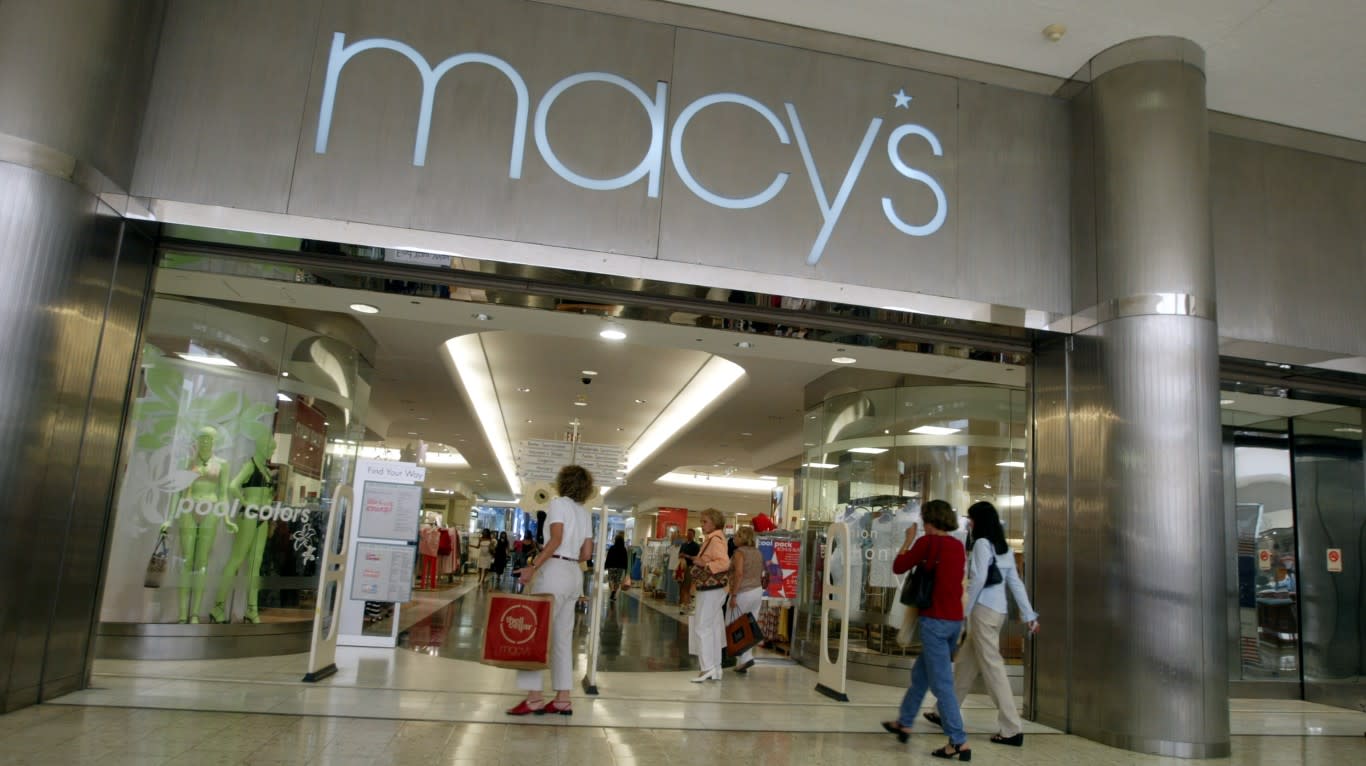
Macy's (NYSE:M) stock is up 5% in Wednesday morning trading, with shares climbing toward $18 after the company posted a stronger-than-expected fourth quarter of FY2025. The move stands out given that the broader consumer cyclical sector is down 0.83% today and the S&P 500 has slipped 0.48%, making Macy's one of the few retail names bucking the tape.

The pop comes after a brutal stretch. Macy's shares are still down 22.4% year-to-date and are off 20.89% over the past month heading into today's print. Today's earnings gave investors something concrete to hold on to.

Read: Data Shows One Habit Doubles American’s Savings And Boosts Retirement

Most Americans drastically underestimate how much they need to retire and overestimate how prepared they are. But data shows that people with one habit have more than double the savings of those who don’t.

Macy's reported adjusted diluted EPS of $1.67 for Q4, against a consensus estimate of $1.54. That's an 8.44% beat. Revenue came in at $7.92 billion versus the $6.93 billion estimate, a 14.28% beat that's hard to dismiss as noise.

Furthermore, Macy's GAAP net income hit $507 million, up from $342 million a year ago. Operating income climbed 49.3% year-over-year to $745 million, even as total revenue slipped 1.1% due to the deliberate closure of 64 underperforming stores in fiscal 2025. That's the kind of operational leverage that shows a business getting leaner, not just smaller.

The standout inside Macy's quarterly report was Bloomingdale's, which posted 9.9% comparable sales growth in Q4, its best holiday season on record. All three nameplates (Macy's, Bloomingdale's, and Bluemercury) posted positive comparable sales in the quarter. Moreover, Macy's consolidated comparable sales rose 1.8%.

Macy's CEO Tony Spring set the tone on the earnings call:

"As we wrap up year two of the Bold New Chapter, I'm pleased with the growth and progress we're making against our strategic priorities. At Macy's, we are offering more relevant brands, stronger storytelling and investing in our colleagues so we can better serve the customer. Bloomingdale's exceptional performance underscores its ability to elevate the customer experience and capture demand across premium contemporary to luxury businesses. Looking to 2026 and beyond, we are ready to build on our progress."

Spring's confidence is backed by the numbers. Macy's Reimagine 125 store program posted +0.9% comparable sales in Q4 and +1.0% for the full fiscal year, outperforming the broader fleet. The company is now expanding that program to 200 locations in fiscal 2026.

Amazon (NASDAQ:AMZN) remains a juggernaut that Macy's must contend with. Amazon generated $716.9 billion in trailing twelve-month revenue and has been named the lowest-priced U.S. retailer by Profitero for nine consecutive years. Its online stores segment alone brought in $82.99 billion in Q4 FY2025, up 10% year-over-year.

Macy's answer is omnichannel investment. Credit card revenues grew 17.1% in Q4 to $205 million, and the Macy's Media Network expanded 12.5% to $72 million. These are the kinds of revenue streams that department stores a decade ago didn't have. It's not Amazon-scale, but it's a real business building alongside the core retail operation.

To be clear, the risk picture hasn't disappeared. Some retailers are facing existential pressure, and Macy's own FY2026 guidance reflects real caution. Management flagged tariff headwinds hitting hardest in Q1, and net sales guidance of $21.4 billion to $21.65 billion implies a step down from fiscal 2025's $22.621 billion.

In addition, Macy's adjusted diluted EPS guidance of $1.90 to $2.10 for fiscal 2026 is below the full-year fiscal 2025 result of $2.32. University of Michigan consumer sentiment sits at 56.4, deep in pessimistic territory, which doesn't make discretionary retail any easier for Macy's.

Even with cautious guidance, Macy's management is putting its money where its mouth is. The company's dividend was raised 5% to $0.1915 per quarter, payable April 1. Also, Macy's repurchased 2.3 million shares for $50 million in Q4 alone, with roughly $1.1 billion remaining on its $2 billion buyback authorization. The company's free cash flow for the full fiscal year came in at $797 million.

At a trailing P/E of roughly 10x and a price-to-book near 1x, Macy's valuation reflects deep skepticism about the department store model. The analyst consensus target for M stock sits at $21.40, with 11 hold ratings and just 1 buy. The Street isn't exactly pounding the table on this one.

Today's move is Macy's making the case that execution matters, even in a world Amazon dominates. The question is whether a few strong quarters and a solid Bloomingdale's holiday season are enough to rebuild conviction in a business model that's been under structural pressure for years.

Going forward, caution is warranted with Macy's shares. Whether M stock can sustain today's gains remains to be seen as the broader market's softness continues to weigh on the session.

Most Americans drastically underestimate how much they need to retire and overestimate how prepared they are. But data shows that people with one habit have more than double the savings of those who don’t.

And no, it’s got nothing to do with increasing your income, savings, clipping coupons, or even cutting back on your lifestyle. It’s much more straightforward (and powerful) than any of that. Frankly, it’s shocking more people don’t adopt the habit given how easy it is.