Press
Gerry Adams gives evidence over claims he had role in IRA bombings
Images
1 / 9

2 / 9
3 / 9
4 / 9
5 / 9
6 / 9
7 / 9

8 / 9

9 / 9
Gerry Adams has said he never held any role or rank within the IRA, as he gives evidence in a civil trial in London.

Three men are seeking a High Court ruling that he is personally liable for injuries they received in explosions in London and Manchester.

"I had no involvement whatsoever, in the authorisation, planning or conduct of the bombings in which the claimants were sadly injured," he said.

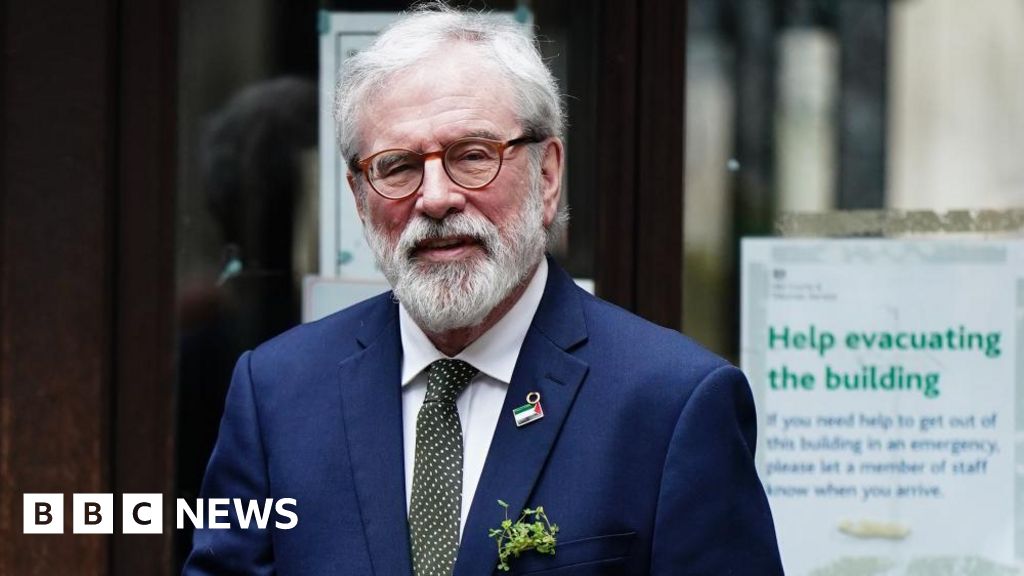
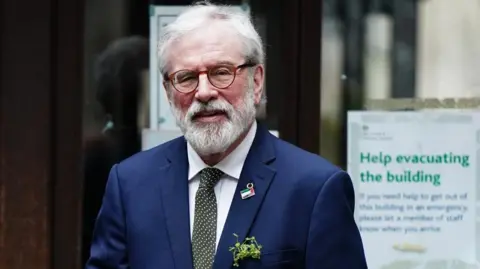
Adams, 77, arrived at court on Tuesday morning, wearing a green tie and a sprig of shamrock in his lapel for St Patrick's Day.

He began by wishing the courtroom a "very happy St Patrick's Day".

In a 20-page witness statement, released to the court as he began giving evidence, Adams states: "I was never a member of the IRA or its army council.

"I never held any role or rank within the IRA."

He goes on to state his "political work" from the late 1960s was well known.

"I worked with many others over many years to bring the conflict in the north of Ireland to an end.

"Although I am retired from front-line politics, I remain committed to assisting all efforts to cement the peace process and to promote Irish unity."

The action was brought by John Clark, a victim of the Old Bailey bomb in 1973, and Jonathan Ganesh and Barry Laycock, who were hurt in the 1996 attacks in London's Docklands and at Manchester's Arndale Shopping Centre respectively.

They are seeking £1 each in "vindicatory" damages.

Adams' lawyers have argued the case is based on "an assortment of hearsay" and that it has been brought several decades too late.

They have said the action should be subject to the three-year limitation period set out in legislation passed in 1980.

This is the sixth day of the trial at the High Court in London, which is being heard by Mr Justice Swift.

Following evidence from 11 witnesses for the claimants, Adams took the stand and will be the only witness in his defence.

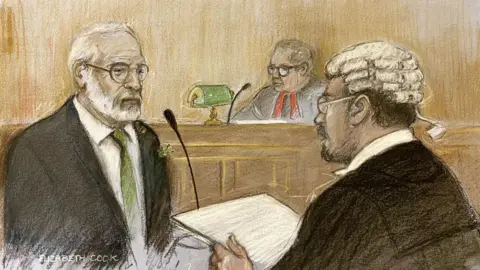
The former Sinn Féin leader is being questioned by Sir Max Hill KC, a former director of public prosecutions in England and Wales, one of the lawyers acting for the claimants.

Sir Max Hill KC said to Adams: "It's your business to defend many actions of the IRA, is that an accurate statement?"

Adams replied: "I do not defend all the IRA actions, but my position is based on the broad principle that people have the right to resist occupation."

Hill added: "You have, over a long period of time, chosen to stand by the IRA."

Adams responded: "I do not stand by everything that they did, but these were my neighbours."

"I'm glad that the IRA has left the stage, I'm glad that no-one else is being killed.

"I am glad that there is a peace process but I do not distance myself from the IRA, while being very, very clear that there were dastardly things that were done that should never have been done."

Hill also questioned Adams about a photo of him at an IRA funeral in which he is wearing a black beret.

Adams said he was part of a guard of honour, of which he was "honoured" to be a part.

Adams added he also took part in the guard of honour at the funeral of former South African president Nelson Mandela, which was "also a great honour".

"But there is no suggestion I was a member of the ANC (African National Congress)," he said.

Hill put it to Adams that both he and the late Martin McGuinness had been "IRA volunteers turned politicians".

"I joined Sinn Féin  at 16 or thereabouts and I have been a political activist for 60 years," he said.

"I never turned politician... I'm not and was not a volunteer of the IRA."

He was then questioned about the 1972 talks between the UK government and an alleged "IRA delegation", which included himself and McGuinness.

Hill said former chief of staff of the IRA, the late Seán Mac Stíofáin, had stated negotiations comprised "exclusively" IRA members.

Adams said Mac Stíofáin had been "mistaken".

He spent almost five hours testifying, before court finished for the day.

Adams will continue giving evidence on Wednesday.

Several former police and Army personnel, called to testify by the claimants, have alleged intelligence material identified Adams as being on the IRA army council from the late 1970s until 2005.

Retired colonel Richard Kemp claimed it was "inconceivable" Adams would not have been involved in authorising the 1996 bombings – the Docklands attack ended the first IRA ceasefire.

It was claimed Adams also had an "instrumental" role in the decision to bomb the Old Bailey in London when he was allegedly a senior IRA figure in Belfast.

The claimants have stated they believe Adams is as culpable as those who planted the bombs.

They raised more than £100,000 through crowdfunding to bring the case.

As a result of a pre-trial ruling, Adams is unable to recover his legal costs from the claimants, believed to be six figures, should he successfully defend the action.

Adams was once charged with IRA membership in 1978, but the case was dropped due to insufficient evidence.

His only Troubles-era convictions, for twice attempting to escape prison while interned without trial in the mid-1970s, were quashed in 2020.

He has been questioned in court before about his alleged IRA past - at the Ballymurphy inquest in Belfast in 2019 and during a libel case against the BBC in Dublin in 2025.

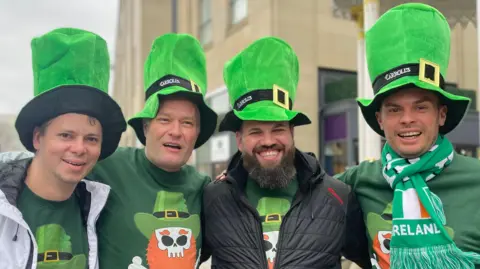
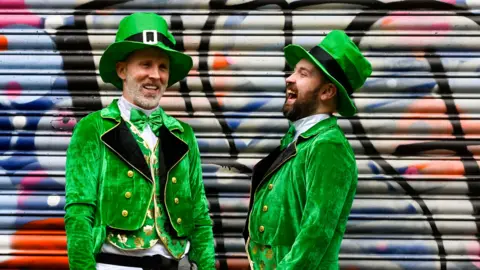
What do St Patrick's Day celebrations look like around the world?

Belfast's annual parade weaved its way through the city centre, with a colourful live performance.

A signed summary of BBC Newsline.

Chris Wynne, from Danske Bank, says scammers pretend to be someone from the fraud team so customers hand over information.

Sinn Féin has expressed its opposition to the BBC becoming an "anchor tenant" at the proposed new Belfast Stories building.