Press
Are the US and Israel waging war on Iran’s cultural heritage?
Images
1 / 4

2 / 4

3 / 4

4 / 4
Iran says at least 56 of its heritage sites damaged or destroyed in war.

Save

Share

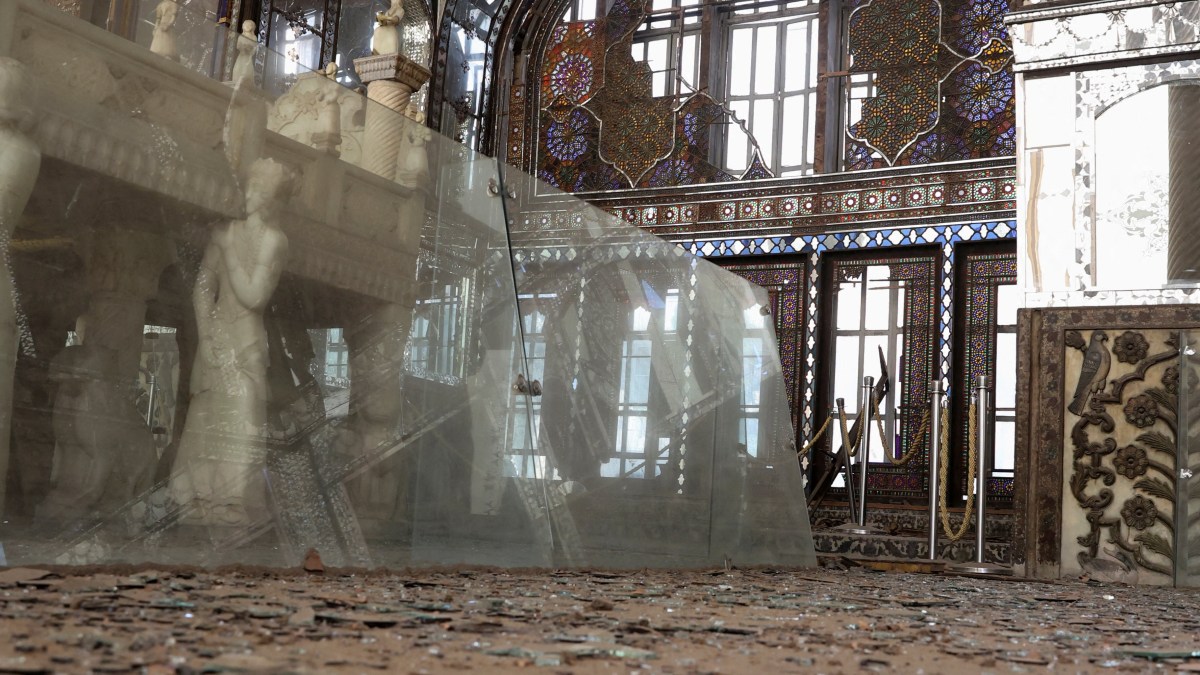
Golestan Palace majorly damaged in US-Israeli strikes on Tehran

Tehran has sounded an alarm about extensive damage to its cultural and historic sites as a result of the United States-Israel war on Iran.

The Ministry of Cultural Heritage, Tourism and Handicrafts said on Saturday that at least 56 museums, historical monuments and cultural sites in Iran have been damaged over the course of the war, which began on February 28, state-run news media reported.

The heritage sites damaged include the Qajar-era Golestan Palace in Tehran.

The Islamic Republic News Agency (IRNA) quoted the Cultural Heritage Ministry as saying the most damage has been sustained in Tehran, where 19 locations were affected. These included Golestan Palace, the Grand Bazaar and the former Senate building.

The ministry’s statement added that historic sites were impacted in Isfahan, Kurdistan, Lorestan, Kermanshah, Bushehr and Ilam provinces. They included parts of Naqsh-e Jahan Square in Isfahan, which, like Golestan Palace, is a UNESCO World Heritage Site.

The ministry added that museums and historic complexes in the cities of Sanandaj, Khorramabad and Siraf were also affected.

Golestan Palace dates to the Qajar era. This 1789-1925 era is marked by the rule of a Turkic dynasty that unified Iran after decades of civil unrest. The Qajar family made Tehran the capital of Iran.

Golestan is a walled palace built combining Persian craft and architecture with European motifs and styles. It features gardens, pools and ornaments. In Persian, “golestan” means “flower garden”.

A video taken by The Associated Press news agency on March 3 showed shattered glass from the mirrored ceilings of the palace covering its floors, broken archways, blown-out windows and damaged mouldings scattered below its glass-mosaic walls.

“This is the grandest surviving structure in the city over the last 200 years, a testimony of how Iranian architects grappled with ideas from the West and integrated them into their own long-established traditions of palatial domestic architecture,” British art historian Robert Hillenbrand told Al Jazeera.

Tehran’s Grand Bazaar is a historic marketplace. Parts of it date back to the Qajar dynasty.

Naqsh-e Jahan Square houses key landmarks, such as mosques and palaces. It was built between 1598 and 1629.

The Falak-ol-Aflak Castle in Khorramabad in Lorestan province was also damaged, according to the head of Lorestan’s heritage department, Ata Hassanpour, who added that the main structure of the castle remained intact.

The Cultural Heritage Ministry’s statement cited international law, including the 1954 Hague Convention and United Nations Security Council Resolution 2347, which call attacks on heritage sites violations of international law.

The Hague Convention, which the US, Israel and Iran are all parties to, aims to protect cultural property, such as art, architecture and historical sites.

“The Convention also provides mechanisms for addressing breaches. These include processes involving the appointment of a commissioner-general for cultural property, who may deal with matters arising from the application of the Convention in conjunction with the parties concerned, and who may also have a role in initiating or conducting an investigation into alleged violations,” Bijan Rouhani, senior researcher in endangered archaeology in the Middle East & North Africa (EAMENA) at the University of Oxford, told Al Jazeera.

Security Council Resolution 2347, which passed in 2017, condemns the unlawful destruction of cultural heritage, including religious sites. The US voted in favour of this resolution.

Israel and the US have insisted they are precisely targeting military targets in Iran.

However, they have been accused of targeting civilian infrastructure in Iran along with heritage sites.

Global rights group Amnesty International said on Monday that a US-manufactured Tomahawk missile was likely used in an attack on an Iranian primary school that killed at least 170 people, most of them children, on February 28. In all, more than 1,400 people have been killed in the US-Israel attacks on Iran so far.

UNESCO, or the United Nations Educational, Scientific and Cultural Organization, has confirmed that it has verified damage to historic sites in Iran.

They include Golestan Palace and two sites in Isfahan, the 17th-century Chehel Sotoun Palace and the Masjed-e Jame, Iran’s oldest Friday mosque.

The UN agency has additionally verified damage to buildings near the Khorramabad Valley, an area that contains five prehistoric caves and a rock shelter with evidence of human occupation dating back to 63,000 BCE.

UNESCO said that before the war, it had provided all parties with the geographical coordinates of heritage sites so they could “take all feasible precautions to avoid damage”, The AP reported.

Nearly 30 sites are designated as under special protection as part of UNESCO’s World Heritage list.

Iranian Foreign Minister Abbas Araghchi has criticised UNESCO’s response.

In an X post on Thursday, Araghchi wrote: “It’s natural that a regime that won’t last a century hates nations with ancient pasts. But where’s UNESCO? Its silence is unacceptable.”

Past conflicts in the Middle East have also destroyed cultural heritage sites.

The 2003 US‑led invasion of Iraq set the stage for the looting of the Iraq National Museum in Baghdad, where thousands of artefacts were stolen or destroyed.

In 2015, ISIL (ISIS) fighters released a video showing the destruction of the Temple of Baalshamin, an ancient place of worship in Palmyra, Syria. It was one of the best-preserved ruins in the city.

They also bulldozed parts of the Mosul Museum in Iraq in the same year. They released a video, showing the destruction of statues and ancient artefacts, some dating back to the seventh century BCE.

Over the course of Israel’s genocidal war in Gaza, which began in October 2023, nearly 200 sites of historical importance had been destroyed or damaged as of February this year, according to UNESCO.

In December 2024, Israel struck Gaza’s Great Omari Mosque, the city’s largest and oldest mosque, which was established in the seventh century.

“In terms of long-term impact, Iran’s cultural heritage was already under significant pressure before this conflict, owing to lack of resources and funding, neglect, development pressure, looting and illicit trafficking,” Rouhani told Al Jazeera.

“There is now a serious concern that, given the combatants involved, international assistance for post-conflict repair and conservation may not be as readily available as it has been in some other recent conflicts, where post-conflict restoration became a major international endeavour.”