yahoo Press
Tech stocks today: Broadcom expands partnership with Google, Anthropic
Images
1 / 7

2 / 7

3 / 7

4 / 7

5 / 7

6 / 7

7 / 7
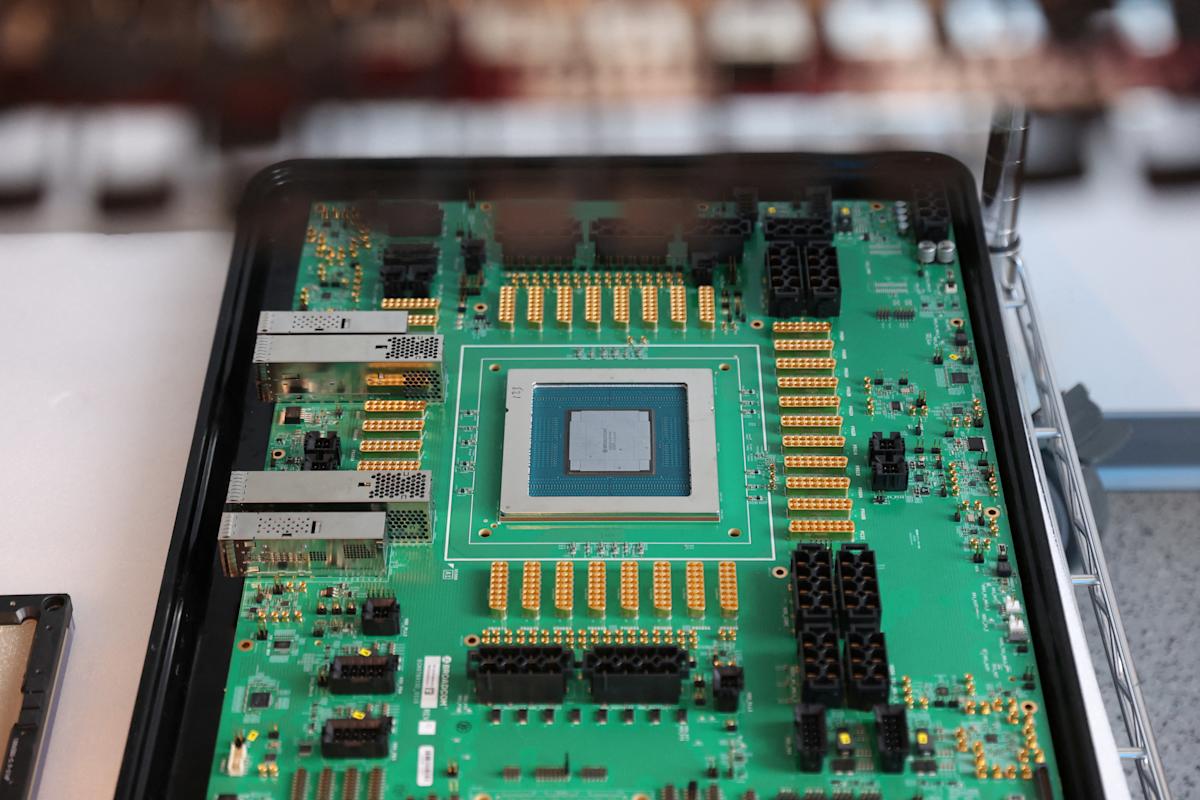
US tech stocks were on a weaker footing in premarket trading as investors looked toward hopes for a truce in the war in Iran. The hostilities in the Middle East have weighed on tech stocks for weeks, clouding the picture of whether investors are pulling back because of the war or because of sentiment toward Big Tech more generally. On the AI front, Broadcom (AVGO) expanded its collaboration with Google (GOOG) to supply the Big Tech company with custom chips and networking and agreed to provide additional compute capacity to Anthropic (ANTH.PVT). On Monday, OpenAI released a series of policy proposals, which it says are meant to start a conversation about how governments should address the projected social disruption AI will cause, from social safety nets to taxes. Meanwhile, anticipation continues to build around two major IPOs: one from Anthropic expected as early as this year, as well as the public debut of Elon Musk’s rocket company, SpaceX (SPAX.PVT). On Thursday, Bloomberg News reported that SpaceX was chasing a $2 trillion valuation. That figure would put SpaceX’s valuation above that of Musk’s Tesla (TSLA), which had a rough week after its first quarter delivery numbers missed estimates. Read more about today's market action. Broadcom (AVGO) deepened its collaboration with Google (GOOG) and Anthropic (ANTH.PVT) with a pair of deals, sending the stock up 3% in premarket trading. The chipmaker agreed to produce Google’s artificial intelligence chips known as tensor processing units, or TPUs, and will give Anthropic access to around 3.5 gigawatts of computing capacity starting in 2027, according to filings. Broadcom will also provide networking infrastructure for Google’s AI racks through 2031. Anthropic’s consumption of the expanded AI compute is dependent on the AI startup’s continued commercial success, the filing said. Anthropic said the significant expansion of its compute infrastructure will power its frontier Claude models and meet “extraordinary demand” from customers. Anthropic added in a blog post that its revenue run rate has now topped $30 billion, up from $9 billion at the end of 2025. Read more here. Iran’s Revolutionary Guard Corps has threatened to attack OpenAI’s (OPAI.PVT) enormous Stargate data center in Abu Dhabi if President Trump proceeds with his threat to attack Iranian power plants. In a video posted on April 3 to the state-backed Tehran Times’ X account and previously reported by Tom’s Hardware and The Verge, a spokesperson for the regime said power and information infrastructure facilities, including the Stargate data center, will face “utter annihilation.” The video then shows images of Stargate, as well as a lineup of its prominent backers, including OpenAI CEO Sam Altman and Nvidia CEO Jensen Huang, although it also misidentified two individuals as Apollo CEO Marc Rowan and Microsoft CEO Satya Nadella. (Disclosure: Yahoo is a portfolio company of funds managed by affiliates of Apollo Global Management.) OpenAI announced the Stargate data center in Abu Dhabi, United Arab Emirates, in May 2025, saying that the site will eventually contain a 1-gigawatt AI cluster, with 200 megawatts scheduled to come online in 2026. Iran has already launched attacks on other data centers in the Middle East, including an Amazon (AMZN) data center in Bahrain. OpenAI (OPAI.PVT) released a series of policy proposals it said are meant to address what it sees as some of the major societal challenges that will inevitably arise from the growth of ever more powerful forms of artificial intelligence. The proposals, which OpenAI admits are “ambitious” and “intentionally early and exploratory,” include everything from a new industrial policy agenda to modernizing the tax system to expanding access to healthcare coverage and retirement savings. They are meant to help answer questions about job disruptions and AI systems that evade human control, and to protect against governments deploying AI in ways that run counter to democratic values. “Unless policy keeps pace with technological change, the institutions and safety nets needed to navigate this transition could fall behind,” the company said. “Ensuring that AI expands access, agency, and opportunity is a central challenge as we move towards superintelligence.” Read more here. Tesla’s expectations for this decade have collapsed, and its share price may soon follow, according to one analyst. JPMorgan’s Ryan Brinkman wrote in a note on Monday that the recent rise in Tesla shares and analyst price targets during this collapse in expectations imply a “sharp pivot” in Tesla’s performance beyond this decade, as my colleague Brian Sozzi reported this morning. "We advise investors cautiously approach this expectation within the context of both execution risk and the time value of money," Brinkman said. He added, "Investors should in our view be mindful when assessing the implied inflection higher in Tesla performance starting sometime beyond this decade (when results are presumably expected to begin tracking materially stronger than earlier expected, in contrast to materially weaker than earlier expected)." Brinkman reiterated a Sell rating on Tesla. His $145 price target estimates Tesla's stock plunging about 60% from current levels. Read more here. The year’s second fiscal quarter is officially underway, and Big Tech is already facing a number of major challenges. There’s the question about when companies will start to see significant returns on the massive sums they’re spending on AI data centers; Microsoft (MSFT) is contending with its worst stock performance in years; and the war in Iran and resulting fuel crisis continue to suppress shares of some of tech’s biggest names. Take a look at the Magnificent Seven stocks, and you’ll find that each is down following its most recent earnings report, despite the fact that the majority of them posted better-than-anticipated results. All of that’s setting up a particularly interesting start to Q2 for Big Tech. Read more here. Microsoft (MSFT) will invest 1.6 trillion yen ($10 billion) in Japan between 2026 and 2029 to expand artificial intelligence infrastructure in the country and deepen its cybersecurity partnership with the government. The announcement builds on Microsoft's $2.9 billion investment in Japan in April 2024. To meet Japan’s AI demand, Microsoft said it’s partnering with Sakura Internet (3778.T) and SoftBank (SFTBY) to build compute capacity through Azure while keeping data within the country. Although US markets were closed on Friday, Sakura Internet stock surged 20% in Tokyo. Other initiatives Microsoft announced as part of the program include mutual intelligence sharing with Japan’s National Cybersecurity Office and a workforce training program, where Microsoft will train 1 million engineers and developers in collaboration with the companies Fujitsu, Hitachi, NEC, NTT Data, and SoftBank. SpaceX (SPAX.PVT) has raised its target valuation to $2 trillion, according to a Bloomberg report citing people familiar with the matter. At that valuation, SpaceX would be one of the most valuable companies in the world, surpassing Meta (META) and Elon Musk’s Tesla (TSLA) in market cap. It would also make Musk the world’s first trillionaire. The rocket and space exploration company formally kicked off its IPO process this week in a confidential filing. It is currently valued at around $1.44 trillion, according to Yahoo Finance data. Read more here. Amazon (AMZN) is responding to the steady increase in fuel prices related to the US war in Iran by tacking on a surcharge to the cost for third-party sellers that use the company’s shipping fulfillment service. “Elevated costs in fuel and logistics have increased the cost of operating across the industry,” an Amazon spokesperson said in a statement to Yahoo Finance. “We have absorbed these increases so far, but similar to other major carriers, when costs remain elevated we implement temporary surcharges to partially recover these costs,” the spokesperson added. Amazon says the 3.5% “fuel and logistics-related surcharge” will be added to existing fulfillment fees, but notes that the price is “meaningfully lower than surcharges applied by other major carriers.” Indeed, Amazon isn’t the only carrier that’s adding a fuel surcharge based on the rising costs. The US Postal Service said it is increasing base postage prices on Priority Mail Express, Priority Mail, USPS Ground Advantage, and Parcel Select by 8%, though it still needs to be reviewed by the Postal Regulatory Commission. UPS (UPS) has also adjusted its fuel surcharge in light of increasing prices. Daily tech news live show, TBPN, has been acquired by OpenAI. The deal marks the AI giant’s biggest move into the media space and also sees one of the buzziest media startups in years get a quick takeout. OpenAI closed a mammoth $122 billion funding round earlier this week. Raising gobs of cash is an expected part of OpenAI’s strategy. Acquiring a daily tech news show, before today, was not. Read more here. Microsoft (MSFT) says it’s on a path to developing high-powered frontier models, an acknowledgment that it is looking to wean itself off its dependence on partner models from OpenAI (OPAI.PVT). Microsoft AI CEO Mustafa Suleyman told Bloomberg in an interview published Thursday that the plan is to have “state-of-the-art” models for multiple types of data, known as multi-modal models, including for text, audio, and images. The news comes less than a month after Microsoft shifted Suleyman’s focus in its AI subsidiary to developing its own models, turning development of the company’s Copilot platform over to Jacob Andreou. Microsoft jumped out to an early lead in the AI race thanks to its partnership with OpenAI, which provides Microsoft with the company’s intellectual property through 2032. As of October, Microsoft held a 27% stake in OpenAI Group PBC. The company also recently contributed to OpenAI’s latest fundraising round, which brought in $122 billion at a valuation of $852 billion. Read more here. The AI industry is dealing with the fallout from two security incidents this week that exposed customer data at Mercor and source code at Anthropic (ANTH.PVT). Mercor was hit via a supply chain attack related to an open-source project called LiteLLM. As a result, the hacking group Lapsus$ said they gained access to Mercor’s customer data, TechCrunch reported. Mercor is a company that uses experts in different fields to train related AI models. Its customers include the likes of OpenAI and Anthropic. In a post on X, Y Combinator president and CEO Garry Tan said the hack puts an “incredible amount of [state-of-the-art] training data” from “every major lab” worth billions of dollars online, making it easily accessible to rivals like China and creating a national security problem. Anthropic’s own source code leak, meanwhile, was related to human error, the company told The Wall Street Journal, meaning it wasn’t the victim of a hack or other form of cybersecurity attack. And while the incident didn’t involve the kind of data that powers Anthropic’s Claude, it did include information such as how the company is able to talk AI into performing certain tasks. Marc Andreessen, cofounder of Andreessen Horowitz, wrote in his own post on X that the incidents mark the end of the AI industry’s “we’ll lock it up” approach to cybersecurity. Tesla (TSLA) released first quarter deliveries that missed estimates on Thursday, reporting another slip in sales in a challenging EV landscape. Tesla delivered 358,023 vehicles globally versus 364,645 expected, per Bloomberg consensus, up nearly 8% year over year, though the company’s total from last year was down due to the changeover to the new Model Y, which impacted sales. Tesla produced 408,386 vehicles globally in Q1. Tesla’s energy business deployed 8.8 GWh of energy storage products in the quarter, down sequentially compared to the 14.2 GWh deployed in Q4. Tesla said it would also report Q1 results on April 22nd, after the bell. Read more here. Intel (INTC) stock jumped as much as 9% on Wednesday after the company said it is repurchasing an equity stake in one of its chip plants in Ireland from Apollo (APO), a welcome sign for its turnaround effort. The chipmaker will repurchase the 49% stake in the fabrication facility it sold to Apollo for $11.2 billion in 2024 for $14.2 billion, the company said in a statement. (Disclosure: Yahoo is a portfolio company of funds managed by affiliates of Apollo Global Management.) Former Intel CEO Pat Gelsinger sold the equity stake in the Ireland facility at a time when the company needed to shore up its finances as it looked to regain a leadership position in chip development and manufacturing technologies that it ceded to rivals AMD (AMD) and TSMC (TSM). Intel’s revenue declined 20% year-over-year in 2022, 14% in 2023, another 2% in 2024, and 0.5% last year. Read more here. April 1 marks 50 years since Steve Jobs, Steve Wozniak, and Ronald Wayne (who quickly left the company) founded Apple (AAPL), then called Apple Computers. The company that exists today is a far cry from its humble beginnings in the Jobs’ family garage, where a small team of technology buffs formed one of the most important businesses in modern history. Apple has repeatedly reinvented itself over the years, going from desktop computer maker to portable music player maker to a smartphone giant, and now to a music and video streaming provider. That ability to repeatedly transform itself throughout the years is the key to Apple’s perseverance over the last half-century. Despite facing near bankruptcy in the late 1990s, the company managed to rebuild and now stands as the second-most-valuable publicly traded business in the world. But as AI continues to dominate the tech industry, Apple is widely seen as falling behind its peers. Its AI-enhanced version of Siri is still behind schedule, and the company has been losing AI experts to competing firms. Now Apple will need to once again harness its capacity for change to ensure it’s around for another 50 years. Read more here. In a Telegram post on Tuesday, Iran’s Islamic Revolutionary Guard Corps (IRGC) threatened to strike 18 companies for their involvement in military operations and tracking targets in the Middle East. The companies listed skewed toward Big Tech giants. They were Cisco (CSCO), HP (HP), Intel (INTC), Oracle (ORCL), Microsoft (MSFT), Apple (AAPL), Google (GOOG), Meta (META), IBM (IBM), Dell (DELL), Palantir (PLTR), Nvidia (NVDA), JPMorgan Chase (JPM), Tesla (TSLA), General Electric (GE), Boeing (BA), Spire Solutions, and AI firm G42. The IRGC advised these companies’ employees to leave their workplaces immediately. The US tech sector has increasingly intertwined itself with the Gulf region as the leaders of Saudi Arabia, the United Arab Emirates, and Qatar spend billions to establish an AI hub in the region. Microsoft and OpenAI have pursued data center projects in the region, as has Amazon Web Services, which already experienced disruptions to service due to airstrikes. Tesla has also expanded in the Middle East, launching the Cybertruck and Model Y Performance cars in regional markets while setting up showrooms in Dubai. Anthropic accidentally exposed nearly 2,000 files and 500,000 lines of code that run its Claude Code AI agent app, in the company’s second major leak in a little over a year. The leak, found on Anthropic’s public database by Chaofan Shou, revealed the set of instructions that programmers wrote to build Claude Code’s features. According to the Wall Street Journal, Anthropic representatives sought to remove 8,000 copies and adaptations of the data. Anthropic told the Wall Street Journal that the leak was caused by “human error” and didn’t expose any customer data or sensitive information about its models’ weights. Still, it opens up one of Anthropic’s key products to competitors, who can more easily reverse engineer features with this information. Hackers can also use the source code to learn more about Claude and potentially exploit vulnerabilities down the line. OpenAI (OPAI.PVT) on Tuesday announced it closed its latest funding round, raising $122 billion in commitments at a valuation of $852 billion. That’s more than the $110 billion the company said it raised in February when it was valued at $730 billion. In a statement, OpenAI said it is now generating $2 billion in revenue per month, up from $1 billion per quarter in 2024, and that, at its current stage, its revenue is growing four times faster than the likes of Google parent Alphabet (GOOGL, GOOG) and Meta (META) did. The latest funding round comes ahead of an anticipated IPO this year and was led by heavyweights including Amazon (AMZN), which committed $50 billion in February, and Nvidia (NVDA) and SoftBank (9984.T), which each committed $30 billion. OpenAI said Microsoft (MSFT) also participated. Additional investors included Altimeter, Appaloosa Management, ARK Invest, Sequoia Capital, and Thrive Capital, among others. OpenAI also said it allowed individual investors to join the raise via banking channels, bringing in more than $3 billion. Read more here. Oracle (ORCL) is the latest tech company to begin cutting jobs as the industry continues a broader push to reduce headcount amid heavy AI investments. According to Business Insider, Oracle employees began receiving notices that they were being let go on Tuesday. CNBC, meanwhile, reported that thousands of workers will be impacted by the layoffs. Oracle declined to comment on the reports. The company’s stock rose more than 4% on the news. Oracle is investing billions as part of its massive AI data center build-out, which includes its work with OpenAI (OPAI.PVT) as part of the joint Stargate Project effort. That has spooked some investors over the last year, as they questioned whether Oracle could recoup its massive capital outlay. Shares of Oracle have declined 49% over the last six months and rose 1.75% over the past year. The stock topped out at $345 in September 2025, before pulling back significantly, and as of Tuesday was trading at $142. Oracle received a brief reprieve from traders following its most recent earnings announcement on March 10, when it reported better-than-expected third quarter results and revised its fiscal 2027 revenue higher to $90 billion. At the time, the company said it also had $523 billion in remaining performance obligations, up $29 billion from the prior quarter. That means it has contracts for $523 billion that it must complete before it can get paid out by its customers. Amazon (AMZN) announced on Tuesday that it will provide internet service to Delta Air Lines (DAL) flights via its Amazon Leo satellites beginning in 2028. Like SpaceX’s Starlink, Amazon’s Leo, which stands for Low Earth Orbit, service, relies on a constellation of satellites orbiting the planet to beam internet connectivity to stationary base stations on the ground or, in the case of Delta, to aircraft flying through the sky. The retail and cloud computing giant says that at 370 miles above the Earth, its Leo satellites are 50 times closer to the planet than the geostationary satellite systems that power older, laggy in-flight Wi-Fi services. When up and running, Amazon says that Delta’s planes will feature antennas that can support download speeds as fast as 1 gigabit per second and uploads of 400 megabits per second. That could make it possible to take video calls and stream movies from Netflix while flying. Leo, however, is still playing catch up to Starlink. Amazon says the company currently has more than 200 satellites in orbit with plans for 20 additional satellite launches this year. But Starlink has 10,000 satellites already in orbit and continues to expand that lead thanks to SpaceX’s rocket capabilities. Starlink is also already available on competing airlines including Southwest (LUV) and United Airlines (UAL). Tesla (TSLA) will release first quarter deliveries on Thursday, with another slip in sales expected in a challenging EV landscape. Tesla is expected to deliver 364,645 vehicles globally in Q1, per Bloomberg consensus, up nearly 9% year over year, though the company’s total from last year was down due to the changeover to the new Model Y, which impacted sales. Tesla’s expected total for Q1 2026 is up only marginally compared to a poor quarter for the company last year. In addition, backlash a year ago against CEO Elon Musk’s role in the White House reached its peak, with protests at Tesla dealerships around the globe. Read more here.