yahoo Press
What Are Barnacles Good For?
Images
1 / 12
2 / 12

3 / 12

4 / 12
5 / 12
6 / 12
7 / 12
8 / 12
9 / 12
10 / 12
11 / 12

12 / 12
The post What Are Barnacles Good For? appeared first on A-Z Animals.

Barnacle cement can withstand pressures of up to 5,000 pounds per square inch.

The cyprid larva stage creates a biological deadline that dictates permanent attachment failure.

Scientists discovered barnacle underwater cement thrives due to its unique protein composition and hydrophobic properties, allowing it to form strong bonds underwater.

The settlement stage involves a rigorous surface audit to ensure long-term colonial viability.

Scroll long enough, and you will see barnacles portrayed all over social media as ocean troublemakers. People violently scrape them off ship hulls and sea turtles like they are the problem. In reality, barnacles filter water, feed predators, and build habitats on hard surfaces. This helps organisms establish themselves in otherwise barren areas of the ocean and migrate to new locations. This article explains what barnacles do, where they live, and why they attach to the things they do. It also covers when barnacles signal trouble for a host animal, plus why shipping crews fight them so hard.

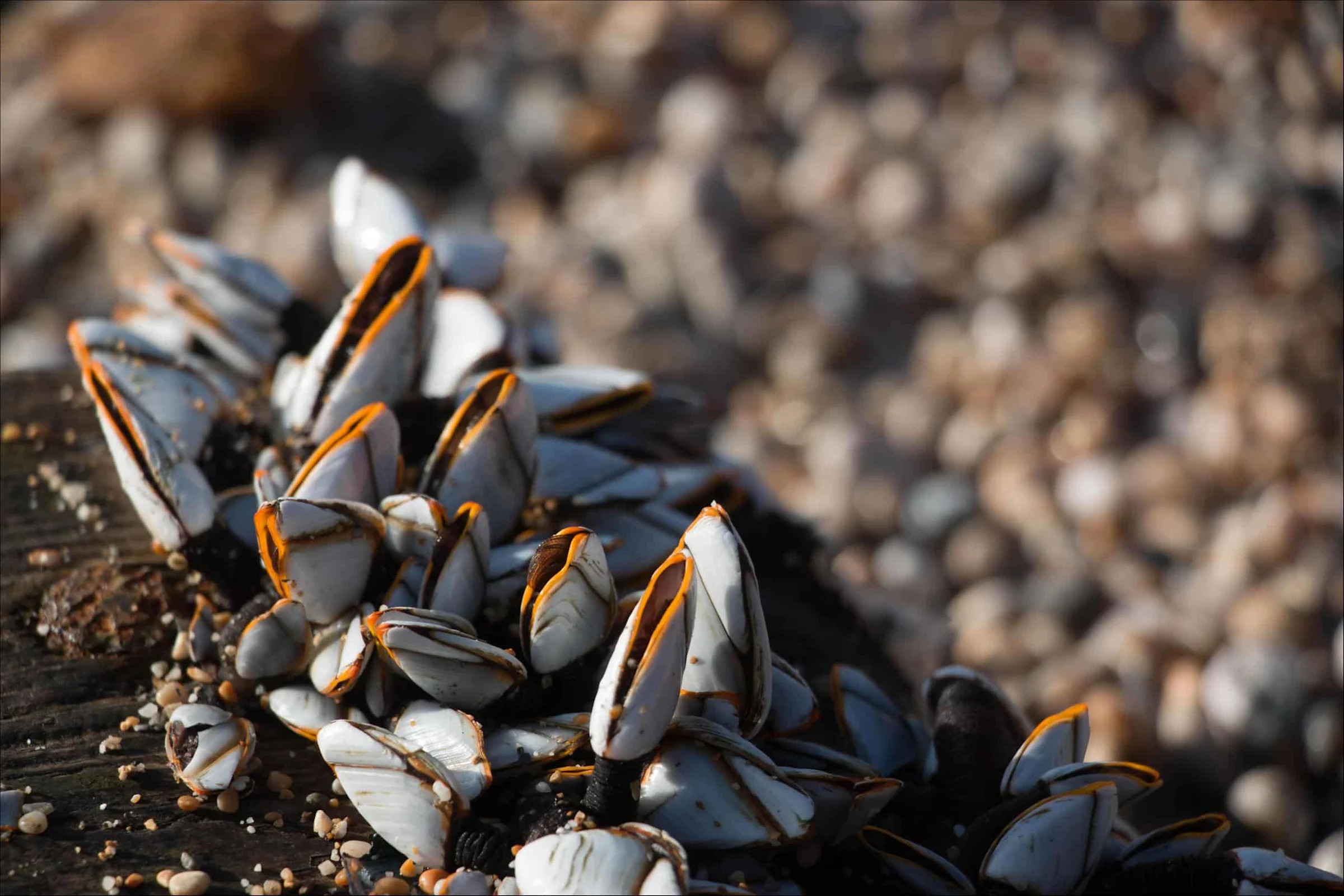
These animals belong to the crustacean group, so they are related to crabs and lobsters. Adults spend most of their lives attached to one spot. A hard shell of calcium plates protects the body inside. Some species form cone-shaped shells that sit tight against a surface. Others grow a stalk and hang outward like a small knob on a string.

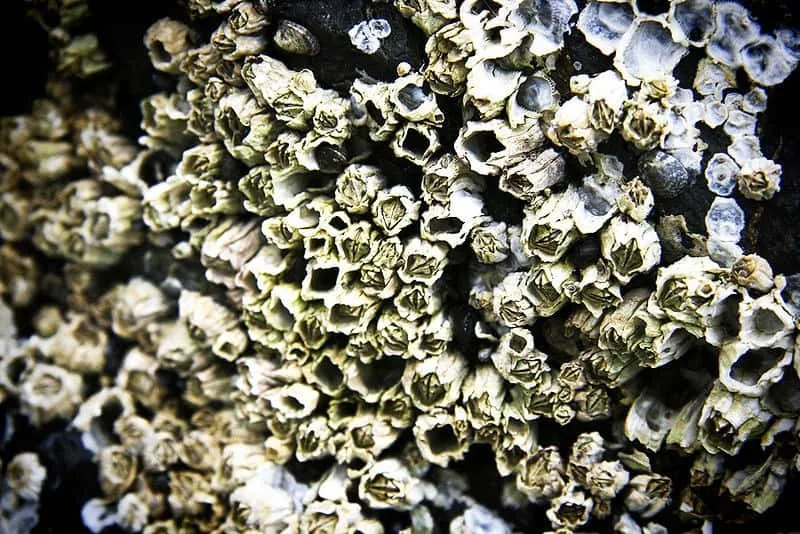
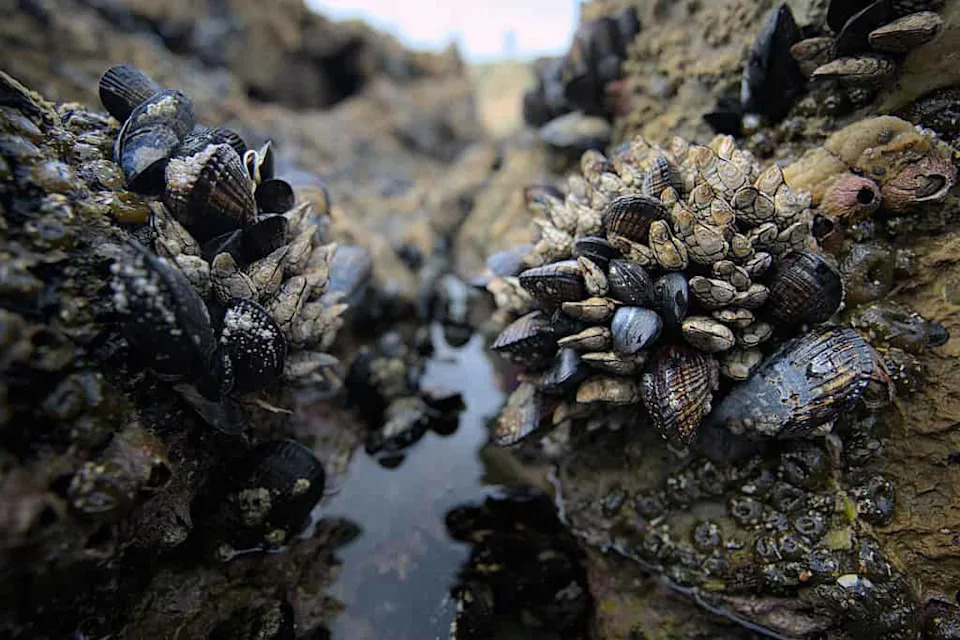
Barnacles attach tightly to rocks along wave-washed coasts, where they filter food from moving water and often grow in crowded clusters.

©Katopia / Creative Commons – Original

Feeding drives their whole design. Barnacles extend feathery limbs called cirri into moving water. The cirri sweep plankton and organic particles toward the mouth. That makes barnacles suspension feeders, which means they eat what the current brings. Along wave-washed coasts, barnacles often crowd together in dense patches. Those clusters cover rocks, pilings, and seawalls, turning bare surfaces into living crust.

A barnacle does not start its life glued down. It begins as a tiny larva that drifts in the plankton. After several molts, it reaches a stage designed to choose a home. This stage explores surfaces, testing texture, and water flow. Once it finds a suitable spot, it releases a strong cement and commits. Once this animal settles down, it remains attached for life.

Attachment happens in a very specific way. The animal fixes itself head-first, using glands connected to its antennae. After that, the body reorganizes during metamorphosis. The drifting form turns into a feeding form. The shell plates develop, and the cirri become the main tools for eating. From then on, the barnacle relies on currents, not movement, to survive. That choice works well anywhere waves or tides keep food flowing past.

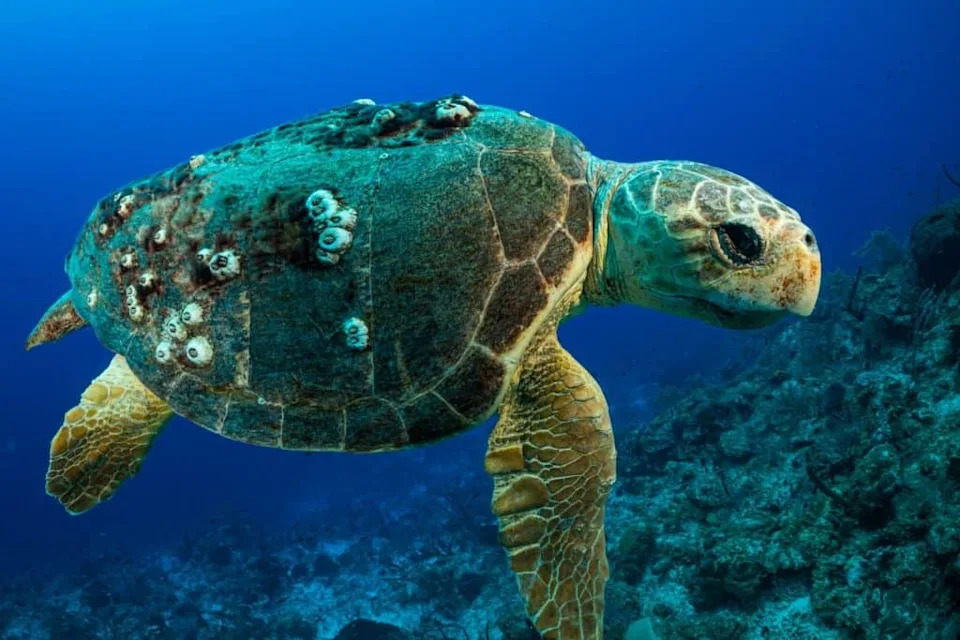
Sea turtles often carry barnacles on their shells, flippers, and softer skin. They are epibionts, which means they live on the surface of another organism. A healthy turtle can carry a modest number of barnacles with limited impact. The turtle still swims, dives, and feeds normally, as long as the numbers don’t get too large. A community of small fish may orbit the turtle to feed on the algae that grow between barnacles.

Barnacles attach to hard surfaces, including sea turtles, where they stay fixed in place and feed on tiny particles carried by ocean currents.

©Drew McArthur/Shutterstock.com

Heavy barnacle loads can mean something else. A turtle that moves slowly gives larvae more time to settle and stay attached. Injury, illness, or poor nutrition can lead to longer surface time and weaker self-cleaning. In those cases, dense barnacle cover acts like a warning sign about the host animal’s physical condition.

Barnacles can slow the turtle’s swimming speed and tire it out, as the turtle must swim harder to overcome the increased drag. However, they also change the turtle’s appearance on the seafloor, helping to camouflage it in barnacle-covered habitats and providing some protection from predators. So as hitchhikers, they are not a total problem, as long as there are not too many of them.

These days, barnacles often trigger humans to intervene in the health of large marine animals. A barnacle-covered sea turtle may attract the attention of researchers and conservationists who want to help it. When removing barnacles, they may discover an injury or illness that caused the turtle to move more slowly, and can then provide treatment. So in a roundabout way, barnacles actually help some turtles by making them noticeable to people who can help them.

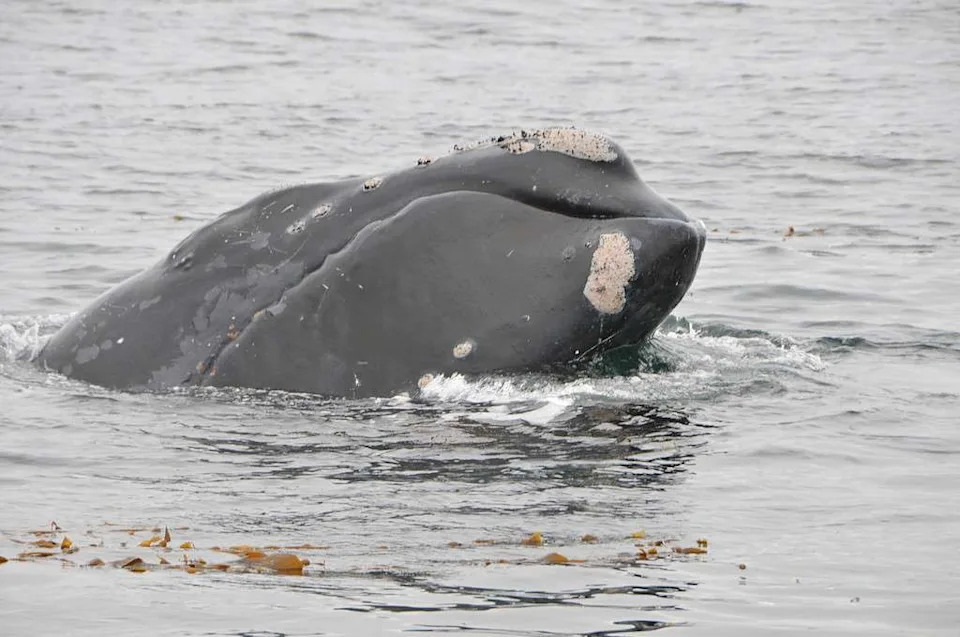
Large marine mammals host barnacles that specialize in holding on through fast travel. Gray whales can carry clusters that form rough patches along the head and back. Around those patches, you may also see “whale lice.” Despite the name, they are crustaceans, not insects. They often gather in skin folds and damaged areas where they can grip and feed.

The barnacle gains a steady ride through food-rich water. The host usually pays a small cost in drag or skin irritation. The cost varies with species and load, but most large whales tolerate it. Researchers can also learn from these riders. Barnacle shells can record chemical signals from the water where they grew. That can support migration research when combined with other data. Manatees and some dolphins can carry barnacles too, especially in regions where they spend time near hard structures.

Barnacles form rough patches on gray whales, hitching a ride through food-rich water while causing little harm to the whale.

©Mark Hoffman and Bruce Long / CC BY-SA 4.0 – Original / License

Living on a fish is harder for a barnacle than living on a turtle shell. Many fish have slippery mucus layers, scales, or fast, flexible movement that knocks settlers off. Barnacles can still succeed on slow-moving fish or bottom dwellers with rougher surfaces. They may also settle on areas that stay stable, such as bony plates or healed scars.

Sharks present another challenge. Their skin has tiny tooth-like structures called dermal denticles that create a rough texture, yet that texture does not always help barnacles. Attachment can occur near scars or damaged spots, or in areas where water flow stays steady. It remains uncommon compared with attachment on shells or rigid surfaces. When you see a fish or shark with heavy barnacle cover, the situation often points to reduced movement or poor condition.

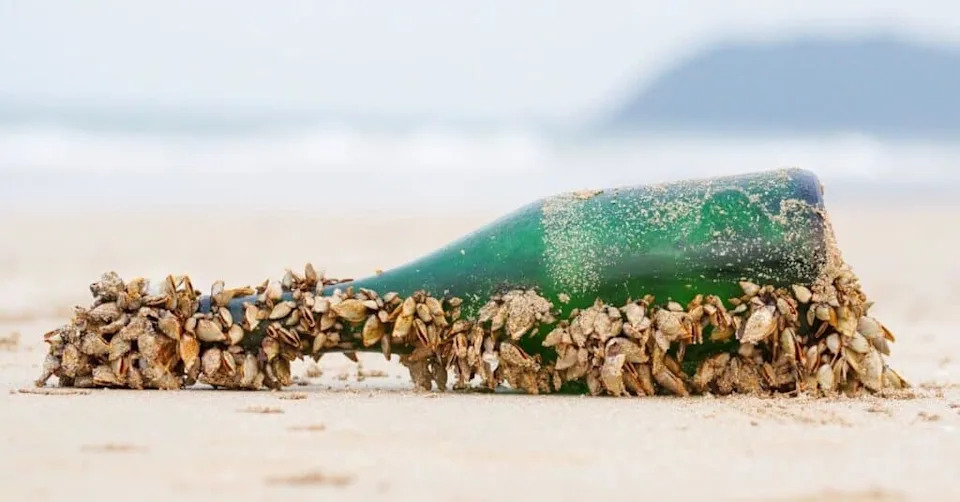
Human structures create barnacle real estate in every harbor. Pilings, docks, buoys, seawalls, and underwater pipes stay submerged for long stretches. Larvae settle fast, and colonies can build thick layers over time. That growth changes the surface into a rough, crowded habitat, just like a natural rocky shore.

Barnacles attach to bottles, boats, and other human-made surfaces, turning them into a rough habitat in coastal waters.

©wk1003mike/Shutterstock.com

Shipping crews treat this as a problem for good reason. Barnacle growth increases drag on ship hulls. Higher drag forces engines to work harder to maintain speed. Fuel use rises, and costs follow. Biofouling can also transport organisms across oceans. A hull can carry attached species into new ports where they do not belong. To limit growth, operators use anti-fouling coatings, maintenance schedules, and hull cleaning. International regulations require some of these procedures to reduce biofouling.

Filter feeding is one of the most important jobs barnacles do. Each individual pulls tiny particles from the water column. On its own, that seems minor. In a dense cluster, it matters. A rock face covered in barnacles contains thousands of feeders working at once. They capture plankton, bacteria, and organic debris drifting by with the current.

This feeding links open-water energy to coastal food webs. Plankton drift through the water column, then barnacles convert that material into body tissue and eggs. Predators then eat the barnacles. That transfer moves energy from microscopic life to larger animals you can see. Barnacles also influence which particles remain in the water near shore. They do not “fix” pollution, and they cannot clean an entire bay alone. Still, their constant filtering affects local conditions in places where they dominate hard surfaces.

Predators eat barnacles in many ways. Whelks drill through shell plates or pry openings along the edge. Sea stars pull plates apart and digest the soft body inside. Crabs chip barnacles off rocks and crush them when the shell is thin. Fish scrape them from hard surfaces in shallow reefs and tide zones.

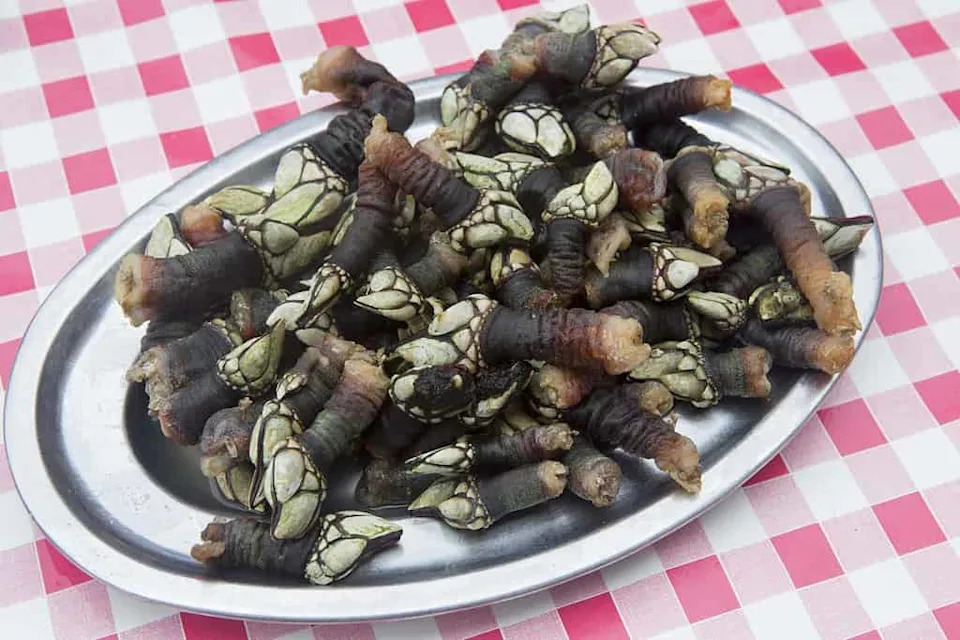
Goose barnacles are a rare seafood harvested by hand from rocky coastlines, where rough waves make collecting them dangerous.

©Valeniker/Shutterstock.com

Shorebirds also take advantage during low tide. When water drops, barnacle clusters sit exposed on rocks and pilings. Birds peck at them or knock them loose. In regions where goose barnacles grow, people harvest and eat them, too. Dense barnacle patches can support a lot of feeding because the prey sits packed together. Predators waste less energy searching and can spend more time eating. This changes local behavior and can influence which predators thrive along barnacle-heavy shorelines.

Crowded barnacles change a flat surface into a rough landscape. Shells stack tightly, leaving gaps, cracks, and shaded pockets. Tiny animals shelter inside those spaces. Juvenile snails, amphipods, small worms, and other invertebrates can hide from waves and predators between the plates.

Algae and microscopic growth also collect on and around shells. That growth attracts grazers, which then attract larger predators. In that way, barnacles act like habitat builders. They create a structure that supports more species than bare rock does. In areas where the seabed is featureless, barnacles are often among the first colonizers of sunken ships or other debris, transforming them into usable platforms for life. Some coastlines rely on these structural species to maintain biodiversity. Barnacles share this role with mussels and oysters in many regions. The exact community differs by site, but the pattern stays consistent. More structure creates more niches, and more niches support more life.

Barnacles can shape how a host moves and rests. Extra drag on a turtle can increase energy demands. A heavily covered turtle may rest more or choose calmer water. That change can affect feeding time and predator risk. Barnacle cover can also shift visibility. A rough shell outline may blend better with a barnacle-covered bottom.

Barnacles cluster tightly on hard surfaces, a behavior that can increase drag and influence how animals move and rest when they attach to living hosts.

©Cavan-Images/Shutterstock.com

Large whales sometimes rub on sand or rock, which may help remove attached organisms. Social contact between whales can also scrape skin. Those behaviors serve multiple purposes, but attached growth can add another reason. Whales breach to communicate, play, or assert dominance, but they might also do so to dislodge barnacles from sensitive or itchy skin.

Barnacles can also act as environmental indicators. Changes in their distribution can reflect shifts in water temperature and chemistry. Growth patterns can respond to local conditions such as nutrient levels and pollution stress. Long-term monitoring of barnacle communities helps scientists track how coasts respond to warming oceans and human development. Barnacles can contribute to invasive species problems through shipping, yet they also help reveal changes that people might miss without careful study.

Barnacles do cause real problems. They increase ship drag and raise fuel use as well as energy requirements for creatures like sea turtles to swim away from enemies. They also create mobile habitats for non-native species, allowing these organisms to travel into new ecosystems on the hulls of ships visiting ports around the world. Those issues deserve attention and management.

At the same time, barnacles support ocean food webs. They filter water, feed predators, and build habitat for smaller creatures. They also provide researchers with useful clues about host health and habitat use. A barnacle does not care whether a human calls it a pest. It follows a life strategy that has worked for millions of years. If you want a fair view of barnacles, judge them by their role in the system, not by how satisfying a scraping video looks.

The post What Are Barnacles Good For? appeared first on A-Z Animals.